
14 Ocak 2015 Çarşamba
The Enigmatic David Bowie
Absolutely fabulous, always cool ... the morphing looks of DB over the years.

13 Ocak 2015 Salı
Research Quality at Queen's University Management School
Every six years or so, the UK university system is subject to a research assessment exercise (currently known as the Research Excellent Framework - REF). The stated purpose of this exercise is to guide government funding for universities to those doing the best research. The 2014 REF assessed the quality of research outputs (books and journal articles), the quality of research environment, and the societal impact of research over the period 2008-2013. Each broad university discipline got a score somewhere between 1* (not good) and 4* (top of the pile).
The results of REF 2014 were released just before Christmas. Many university departments and universities were delighted with the high grade point average (GPA) scores they achieved. But a deeper analysis of the results reveals that there was a lot of game playing taking place. First, some university departments only submitted their best researchers, which pushed up their GPAs. But this doesn't reflect the true research quality of that particular department. Second, some universities created research institutes (for an example click here) which excluded most staff in the department or faculty, but for the purposes of the REF, the research institute was the department. Click here to read more about REF game playing.
Queen's University Belfast did not engage in REF game playing. In terms of GPA, it ranked 42nd out of 101 institutions, but when its GPA is weighted by the percentage of staff submitted to REF (research intensity), it jumps to 8th in the UK (click here)! In terms of Queen's University Management School (QUMS), we jump from joint 34th to 9th in the UK! The Association of Business School's analysis of the REF results, which looks at breadth and depth of research, places QUMS 13th in the UK - click here for their league table.
Overall, the 2014 REF results suggest that Queen's University Management School is in the top decile of UK business schools. Why has it been able to achieve this? Two reasons. First, it has a rich research culture inhabited by remarkable academics. Second, it has amazing PhD, MSc and BSc students who inspire academics to engage in world-leading research.
12 Ocak 2015 Pazartesi
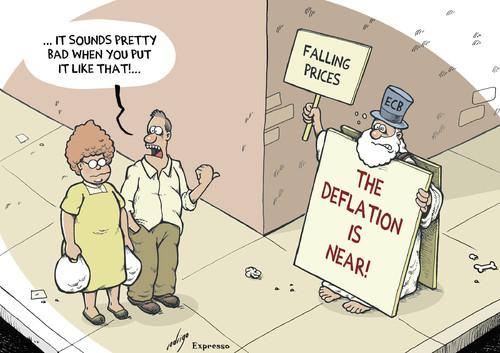
Is Deflation Good, Bad or Ugly?
The Eurozone has recently moved into deflationary territory (story here). But is deflation such a bad thing? Deflation has two major consequences. First, it means that debtors have to pay back more in real terms than they borrowed (inflation, on the other hand, helps debtors by reducing the real amount they have to repay on their loan). This, as was the case in the Great Depression of the 1930s, can have detrimental consequences for financial stability. Second, nominal wage rigidity makes it very hard for employers to reduce nominal wages in line with deflation. What does the historical experience with deflation have to say? Click here to read a BIS working paper by Michael Bordo and Andrew Filardo which looks at deflation in a historical perspective. They find that some deflation experiences have been good, other have been bad, and some have even been ugly.
Great Food Find ... Steamed Fish @ 1990 Prices

Specialty is their steamed fish with ginger, or rather river fish. I know some may not like river fish being steamed as they say you can taste the mud, seriously folks ... thats too atas.


Look at the bill ... two steamed fishes, a veggie dish plus taugeh dish and tea ... RM87.20!!! Food rating: 9/10. Ambience: 1/10. Value for money: 10/10.
LOCATION: (take note of the word "behind")
Behind - 91 Jalan Waras 3, Taman Connaught Cheras, Kuala Lumpur, 56000, Kuala Lumpur, WP Kuala Lumpur, 56000 (opens for lunch and dinner)

18-20, Jalan 15A/142,
Taman Orkid Desa,
56100 Cheras, KL.
Tel : 016-665 6331
Operation Hours : 05:30PM - 10:00PM
Closed on every Wednesday
9 Ocak 2015 Cuma
Let's Listen To What David Suzuki Has To Say
DAVID SUZUKI CRIES FOR HIS GRANDKIDS
David Suzuki, Founder of the David Suzuki Foundation
If I were to say that this 20 minutes interview was the best piece of radio I have heard for the longest, that would be short changing it. Thats because the subject matter is graver than religion. Its relevance greater than most of us would like to admit. Its humbling, even guilt-inducing at times because we can care more. I am still thinking how we can make the things he said more "actionable for normal people", its too safe to just nod and say that was great radio and content.
http://www.bfm.my/breakfast-grille-david-suzuki.html

8 Ocak 2015 Perşembe
Asset Class Performance As At 31 December 2014
I don't know about you but the recent calamity in the markets, caused by a massive drop in oil prices and to a lesser extent other commodities, plus a sharp rise in USD vis a vis most currencies ... kind of makes me mad. Why ... why is it that the US does not get punished for printing truckloads of currency, why their debts need not be serviced ... and when they have to raise rates, all the smaller nations get whacked.

US real estate investment trusts (REITs) led the performance race in December among the major asset classes, rising a healthy 1.9% in the final month of 2014. US REITs were also the top performer for the calendar year among the major asset classes. For the rest of the field, returns in December were mostly flat to negative. The big loser last month and for 2014 as well: commodities. The US stock market was flat last month, although for year just passed US equities earned a respectable 12.6% (Russell 3000). That’s a comparatively soft gain relative to the stellar advance for US market in the last few years, but it’s above average in comparison with long-term results.
Meanwhile, portfolio diversification faced strong headwinds last month and for 2014 overall. The Global Market Index (an unmanaged benchmark that holds all the major asset classes in market-value weights) retreated 1.1% in December. For all of 2014, GMI earned a relatively soft 4.1% — a sharply lesser gain vs. 2013’s 14.2% advance.
Meanwhile, portfolio diversification faced strong headwinds last month and for 2014 overall. The Global Market Index (an unmanaged benchmark that holds all the major asset classes in market-value weights) retreated 1.1% in December. For all of 2014, GMI earned a relatively soft 4.1% — a sharply lesser gain vs. 2013’s 14.2% advance.
GMI’s diminished performance last year is disappointing in the context of recent history, but the downsizing of return isn’t particularly surprising. Forward-looking risk-premia estimates for GMI have been in the neighborhood of 4.0% lately (see last month’s update, for instance). By contrast, GMI’s historical risk premiums have been running at roughly twice that pace in the last several years, based on the trailing three-year period. But as December’s numbers suggest, the wide gap between hefty profits in the rear view mirror and lean expectations for the future is closing.
The implication: minting impressive returns with a passively managed multi-asset class strategy is going to get tougher in the foreseeable future. The solution for sidestepping softer results? The standard toolkit, of course — excelling in rebalancing and/or second-guessing Mr. Market’s asset allocation. In other words, generating a portfolio return that’s comparable to what we’ve seen over the past five years will probably require a higher dose of risk.
5 Ocak 2015 Pazartesi
Greece Is The Word ...
Why the renewed talk of a Grexit from the eurozone?
Greek Prime Minister Antonis Samaras has called a snap election for January 25. Unfortunately for Mr Samaras, the narrow front-runner for the election is his opponent Alexis Tsipras, head of the leftist Syriza party. Mr Tsipras wants Greece to remain in the Eurozone, but he also wants parts of Greece's debt written off and austerity measures reduced. It's not certain whether the rest of the Eurozone - and in particular, Germany - will accept this. Greece could be forced to leave the Eurozone.
What would happen to Greece if it left the eurozone?
The scenarios range from mildly painful to catastrophic. At the very least, leaving the euro and writing off large amounts of debt would make Greece a pariah in international capital markets - who wants to lend money to a country that doesn't repay? Greece would be forced to reintroduce its old national currency, the drachma, and it would be a difficult transition from the euro. But Greece would again have its own currency and central bank and be able to directly steer its economy.
Still, the resulting turmoil could make Greece's economic position even worse than it currently is. The doomsday scenario is political unrest that could lead to civil war and a military coup.
What would happen to the European and world economies if Greece left the eurozone?
Europe's economic position is far better now than the crisis years of 2009 and 2010. German leader Angela Merkel has stated that she would be willing to accept a Grexit because the feeling is that the Eurozone would be able to hold together if Greece left. This would still be enormously expensive - costing billions of Euros - and financial markets worldwide would take a hit. American academic Barry Eichengreen said the impact of Greece leaving the euro would be "Lehman Brothers squared".
Previously, it was believed that if Greece wrote off their debt and left the euro, other troubled European economies - Portugal, Ireland, Spain, Italy - could follow. There is still a small chance this could happen. The implosion of the Eurozone would have dire consequences for the Europe and the world.
So how bad is Greece's economy?
Since 2008, the year the global financial crisis began, the economy has shrunk an astounding 25 per cent. If the Greek economy grew at 2 per cent a year, it would still take 13 years to get back to its 2008 size.
Greece's debt as a proportion of GDP was 105.4 per cent in 2008. It soared to 171.3 per cent in 2012, shrunk to 156.9 per cent in 2013, but reached 174.9 per cent last year - higher than ever. Only Japan has worse debt. Greek unemployment is at 25 per cent. And because Greece has neither its own currency or central bank, it can't devalue the exchange rate or introduce monetary stimulus to improve its economy.
In short - the Greek economy is in terrible shape.
What do bond markets think about a Grexit?
Southern European bond yields have risen in recent days but are still very low, reflecting the belief that the fallout from a Grexit can be "ringfenced". Spain's 10-year yield touched a record-low 1.49 per cent on January 2 and is now at 1.60 percent. Italy's 10-year rate reached a record low 1.73 per cent on January 2 and is now at 1.83 per cent.
By contrast, the Greek 10-year yield has increased 41 basis points to 9.65 per cent. Despite the rise over the past weeks, it's still well below record high yields of more than 30 per cent hit in 2012.
Kaydol:
Kayıtlar (Atom)