interest rate etiketine sahip kayıtlar gösteriliyor. Tüm kayıtları göster

16 Aralık 2015 Çarşamba

US Fed Rate Hike: Good or Bad? How is it going to impact Malaysia?

Everyone are anxiously waiting for the outcome of Federal Reserve of US (FED) tonight. If the rate was really raised, it will be the turning point of the interest rate direction. Should FED make the decision to hike it, is it good or bad for the global economy? And most importantly, how is it going to impact Malaysia?


It's not news anymore since we're talking about this FED rate hike issue one and half year ago. But, the fact is, it does really has a great impact to the world economy, and Malaysia cannot spare from it either.

Generally, below is the 3 possible outcome of 16th Dec 2015 and the possible reactions of global markets:

  1. Unchanged
    Although this is unlikely this round, yet FED still has the chance to remained unchanged and keep it for the next round. While most of us already factored in the effect of raising interest rate, this outcome would make the whole global markets to react positively (although it maybe short lived until the next FED meeting). Merry Xmas and happy new year.

  2. Up 0.25 basis points (bps)
    This is the most popular and expected outcome. Since it's already expected by all of us, including all investors and fund managers, the reaction from this outcome would be muted. Meaning, it's business as usual until the next signal on whether how many more hikes in year 2016.

  3. Up more than 0.25 bps
    This is possible also, depends on how confident was FED regarding the US economy is doing currently. Based on the US economy data for past months, it's convincing enough to raise rate. But, how much should be raised it's still in guessing mode. So, if the outcome is more than what most of us are expecting, it will be a 'cautiously pessimistic' mode for the global markets. No more Merry Xmas for investors.


Anyway, either up or unchanged, we can't deny that Malaysian currency MYR will be the worst performing currency in year 2015. But, the impact from tonight's FED outcome would determine whether the worst is over or not for us. For scenario 1 and 2, it's good or neutral for MYR. However, it will be a nightmare again if for scenario 3.


Then, can we revert the situation ???

Yes, if Bank Negara Malaysia decided to raise our OPR rate by following the footsteps of FED. Then, it could strengthen MYR abit or at least minimized the impact from FED rate hike. However, by doing so, BNM's action risks jeopardizing the local economy growth while trying to put a stop on capital outflow. It's a difficult decision to make.


Good Luck.

7 Ekim 2014 Salı

Is it Viable to opt for Fixed Rate Loan currently? (Oct 2014)

In anticipation of rising interest rate environment, would fixed-rate loans be a better option for borrowers? To recap, Bank Negara Malaysia, for the first time since 2011, raised the benchmark reference rate OPR to 3.25% in July 2014. While many anticipate that there will be another round of hiking soon, should loan borrowers opt for fixed rate loan?


What is Fixed-Rate loan?
By fixing your interest rate upfront, fixed rate loans protect borrowers from future increases in Base Lending Rate (BLR). In other word, the repayment amount will not be changed during the entire loan period.

Who is suitable for fixed rate loan?

Perhaps, if you are looking to avoid any volatility, in terms of interest rate movements, you may opt for fixed rate loan. However, it's not necessarily so in terms of paying lower interest rate. 

Why say so?
Normally, the interest rate on a fixed rate loan was set slightly above what you would be quoted for a floating rate. So, if the financial institutions expect rates to rise, they would quote higher fixed rates too !!! If you think you're clever, your banker also not stupid...


So, how to make decision?
To decide, one must know where are we today and how much more interest rates will rise. With the current BLR of 6.85% coupled with a discount of 2.4%, the net interest rate borrowers are serving now is 4.45%. As far as we know, the average fixed interest rate currently available is 5.00%, which is 55 basis points above current floating rate.

Based on historical OPR movements, there is just another 25 basis points to reach the pre-crisis level of 3.50%. Meaning, there is still another 30 basis points to go beyond the 3.50% OPR level before reaching the fixed interest rate. Since there is still a wide gap to reach the 5.00% level, it's not so attractive to take up fixed rate loan currently.

What do you think?

30 Temmuz 2014 Çarşamba

Why Banks offering attractive FD promotions now? (July 2014)

Once again, we came back to this topic again. The Fixed Deposit promotion offered by various banks lately. Since FD seems to be a form of liability to banks (because banks need to pay depositors interest rate no matter rainy or shiny days), why they still launching FD promotions? What's the rationale behind?


Exposing the mystery ...


  1. Implementation of Basel series:
    The main objective of these series was to strengthen the existing capital and liquidity standard of banks as set and governed by Bank Negara Malaysia. With these series, banks would need to have more capital and liquidity to continue their main business in disbursing loans. So, they need our money being locked for a longer period via FD.

  2. In anticipation of higher interest rate:
    Yes. This is another main reason why banks offering attractive FD rate to tie up your money. Because they foresee that BNM will raise the OPR rate, hence FD rate in the future will rise in tandem. What's wrong if I offer you effective 9 months FD rate of 3.60% when I foresee that same tenure rate may went up to 3.50% eventually ?
At least, banks already lock in your money now and loan it out according to current BLR which will increase in tandem with OPR also. Do you know that BLR increasing with 25 basis points in mid-July, and average FD rate increasing with a lesser extend? So, which side is better off? Depositors or bankers? Another OPR hike in November 2014 ?


Some example of FD promotions by various banks:


20 Mart 2014 Perşembe

NEW Base Rate: Good or Bad ?

When Bank Negara Malaysia (BNM) announcing that the new Base Rate will replace the current Base Lending Rate (BLR) starting 2015, many people doesn't know what's that. Is it a good thing or is it just another gimmick to increase the lending rate?


Here, Finance Malaysia Blog hope to answer some of the queries posted by our followers...


First, let us figure out why BNM wanted to change the reference rate. It was being told that the objective is to promote better transparency, pricing discipline and efficiency among financial players.

Second, how was the new Base Rate being determined?

Third, good or bad ?
In fact, it was a good thing to retail borrowers since the new Base Rate would be partially determined by efficiency of financial institutions. Finance Malaysia opines that those big banks will have a better pricing power compared to smaller banks, because their cost of funding is usually lower via current/saving account (CASA). That's the cheapest cost of funding for any banks, other than Fixed Deposit.


Would it affect the existing loan borrowers?
This is the question most of us concerned about. But, BNM said the new Base Rate "should not" have an effective impact on existing loan borrowers. Of course, it was different story if the borrowers refinance their existing loan, either it's personal loan or housing loan.

17 Şubat 2014 Pazartesi

Super FD with 8.88% ???

Recently, Public Bank wrest its muscle to attracts depositors to place their money with them. This has becomes an annual promotional event to get as much deposits after Chinese New Year. The reason was simple: CNY Ang Pow money... What is so exciting this round?

The campaign is open to all new and existing Public Bank individual customers from 28 Jan till 30 June 2014. All you need to do by placing a minimum RM30,000 deposit. Then, it will be separated into 2 portions, 80% in Special Fixed Deposit (FD) and 20% in Saving Account (SA). 

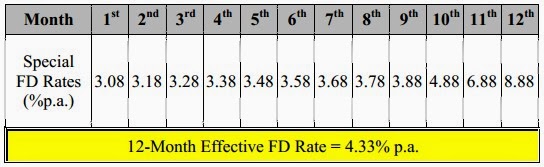
Yes. Depositors can get up to 8.88% p.a. interest on a step-up basis on the 12th month. Can you get it? It's 8.88% p.a. on the 12th month ONLY, not the whole tenure.

So, what's the EFFECTIVE rate that I can get?
Please refer to the below picture...

Not bad what... Wait... This is only on the 80% FD portion. If you add in the 20% SA portion to the whole principal that you have placed, it's lower than 4.33% p.a. actually. Anyway, it's still better than most FD rate offered by other banks. Cheers to Public Bank !!!

How about the FD rate after 12 months?
It will be auto-renewed according to the normal 1-month FD rate by that time (3.08% p.a. currently). So, if you don't like the 1-month FD rate offered, remember to uplift your money after 12 months ya ;)

What if I withdraw within 12 months?
You can do so. But, the interest paid (which is more than the prevailing FD interest rate) will be claw back. Please refer to below example.

22 Temmuz 2013 Pazartesi

A Guide To Home Loan Refinancing

For those who have never been exposed to the concept of “refinancing”, home loan refinancing may seem like a baffling notion.  After all, what good could possibly come from getting a new home loan… just to pay off your old one? Wouldn't you just go back to square one after the whole process? These could be some of the questions you’re asking yourselves, and understandably so.


In reality, home loan refinancing is a widely-adopted practice with many potential benefits. Home buyers far and wide undertake it in order to lower the interest they’re paying on their home loans, reduce their monthly loan repayment amounts, and generally alter their loan terms to better suit their financial needs.  In fact, some even refinance to free up cash riding on the inherent values of their properties!


Want to refinance your home loan in Malaysia?
Click here to compare different rates by different banks.
Courtesy of: iMoney.my

14 Mayıs 2013 Salı

A Malaysian Guide to Home Buying Fees & Charges

Like any other country, buying a house and taking a home loan / mortgage in Malaysia involve legal fees & charges - which many people fail to take into consideration especially when they’re buying a property for the very first time.
So to all Malaysians buying your dream houses right now, allow iMoney to show you ALL the fees and charges involved when you buy a house or apply for a home loan.


1 Mayıs 2013 Çarşamba

The 3rd Way of Shopping ?


Most probably you are reading this while shopping, waiting for your wife/girlfriend trying on a new dress or shoe? Congratulation... You're never be more relevant to read this article. Wait, what is the 3rd way?


1st way ---> Cash

2nd way ---> Credit Card
3rd way ---> ???

Introducing the NEW concept of shopping...


The whole idea behind 3rd way is to promote responsible shopping within our community. With proper planning, you can avoid spending all your cash on the item you want.


Instead, you can shop and be rewarded with the interest rates from saving the extra cash reward. You can plan to spend your money for a gadgets, a journey or whatever items and get amazing deals and pay in the future, helping you to get the things you want hassle free.

After changing the buying concept, you will arrive at an interesting question: "If shopping could be free from pain of credit and the guilt of cash, what would I buy?". Happy answering...

Yup. This is the new concept that is similar to what introduced by Mach by Hong Leong bank such as its Dream JAR Saving account.
What is Dream JAR Saving account?

  • To set your own golds (Samsung S4?)
  • Start with just RM50 or more plus a bit of good planning
  • Choose the period to achieve your goals in 6, 9, 12 or 18 months
  • Save the amount of money set monthly
  • Get rewarded and save more with extra cash when you complete your goal through prompt monthly deposits
  • Get (not pay) an interest of 2% p.a. on ALL balances compared to regular savings accounts which offer tiered based interest rates - calculated on daily basis

By using the 3rd way of shopping, you don't have to worry about repayments or overspending anymore. What else? Cash rewards !!!

16 Nisan 2013 Salı

Consolidating Credit Card Debt: 2 Easy Methods in Malaysia


Credit cards have become a part of life in Malaysia. But as much as they make life a lot more convenient; credit cards can also lead to an unmanageable amount of debt. In some cases, credit cards have even led to bankruptcies.


If you have a credit card debt that seems to be spiralling of control, it may be the right time to consider debt consolidation. In Malaysia, there are two common debt consolidation methods that are highly workable.

1) Credit Card Balance Transfer

Credit Card Balance Transfers involve the transferring of money that you owe on your current credit card account to a new credit card.

Balance transfers offer a number of different benefits, including lower interest rate and the ability to simplify your credit card debt payment process. 

How Credit Card Balance Transfers Can Work for Debt Consolidation:

●     If you have accumulated a significant amount of credit card debt, there is a good chance you are currently being charged the maximum interest rate. Based on the tiered interest rate structure adopted by banks in Malaysia, this maximum rate is generally 17.5% p.a.
●     If you are paying the maximum interest rate, you are probably finding it quite difficult to keep up with your credit card debts. High interest rates can cause your credit card balance to rise quickly. For example, if the amount you owe on your credit cards is RM10,000, you are essentially adding RM146 in interest to your debt each month.
●     A credit card balance transfer could give you a break from paying high interest. In some cases, you'll find balance transfer programmes that offer zero interest rate, at least for the first year or so. By taking advantage of one of these offers, you will have a better chance of paying your debt off.
●     Banks often charge a once-off fee of 3% when transferring a credit card balance. However, in the long run you will still end up paying less, due to the lower interest rate.

Example of How Much You Could Save:

Credit card average maximum interest rate = 17.5%
Lowest known interest rate for balance transfer (for a limited time) = 0%
Amount you could potentially save on interest (for a limited time) = 17.5%

2) Personal Loan

The concept of taking out a personal loan in order to pay off credit card debts might sound a little unusual. However, if you take a strategic approach by taking advantage of interest rate differences between personal loans and credit cards, this method can actually work quite well.

How Personal Loans Can Work for Debt Consolidation:

●     If you have accumulated a significant amount of credit card debt, there is a good chance you are currently being charged the maximum interest rate. Based on the tiered interest rate structure adopted by banks in Malaysia, this maximum rate is generally 17.5% p.a.
●     The interest rates on many personal loans are far lower than credit card maximum interest rates. For example, some personal loan interest rates in 2013 can be 9.88% p.a. or less, depending on your loan amount and term. If you are a government servant, the rate dives even lower.
●     If you take up a personal loan with significantly lower interest than a credit card’s, you could technically be paying much less over the long run. The savings you’re getting from your interest could even help offset the charges and fees associated with the application for a personal loan.

Example of How Much You Could Save:

Credit card average maximum interest rate = 17.5%
Known interest rate on a personal loan = 9.88%
Amount you could potentially save on interest = 7.62%

This article is brought to you by iMoney.my - the first website in Malaysia comparing credit cards, loans and mortgages - free of charge and independently.