6 Temmuz 2013 Cumartesi

New Fund: Eastspring Investments Target Income Fund 2

In the current low interest rate environment, investors continue to chase for yields which resulted in strong demand for close-ended bond funds that potentially offers higher return than fixed deposits. Keeping this in mind, Eastspring Investments is launching a new fund.


The fund endeavors to provide regular income during the tenure of the fund (3 years), by investing in local and/or foreign debt securities.

Investment Strategy
A minimum of 70% will be invested in local and/or foreign debt securities, while the remaining of not more than 40% may be invested either in non-rated debt securities and/or debt securities rated below investment grade rating.

  • lower than BBB3 rating by RAM; or
  • below investment grade rating by other rating agencies

Although the fund is expected to invest up to 40% in non-rated issuers and/or issuers rated below investment grade, there is a risk that this limit may be exceeded as issuers of investment grade debt securities held within the portfolio may be downgraded by rating agencies and thus resulting in the fund's over exposure in such category.


Additionally, up to 30% may invested in money market instruments, and worth to note that the fund may exercise Early Repayment. As such, this is a moderate risk fund, instead of low risk.

The fund is suitable for investors who:-

  • seek regular income distribution;
  • have 3 years investment horizon; and
  • have a moderate risk tolerance.


5 Temmuz 2013 Cuma

Latest BNM measures to Curb Excessive Household Debt (July 2013)

Hot from oven. Bank Negara Malaysia (BNM) today announce some measures to address the alarming household debt among Malaysians. As reported, household debts have continued to increase at a strong pace, averaging at an annual rate of 12% over past 5 years. While this has been supported by positive income and employment conditions, in the more recent period, there has been a growing trend in the offering of financial products that are not in the long-term interest of consumers.


What does this mean?
This includes extended financing tenures of up to 45 years for house financing and 25 years for personal financing!!! Wow... Is it too long the tenure? While this may reduce the monthly repayments, in the long run, this increase the overall debt burden of households. If we don't stop this kind of practice, it will encourage excessive debt accumulation by households and increase the vulnerability of this sector.

Hence, BNM has to take actions...
The implementation of a set of measures aimed at avoiding excessive household indebtedness and to reinforce responsible lending practices by key credit providers. These measures, which take effect immediately, complements the earlier measures introduced since 2010 to promote a sound and sustainable household sector.


What are the measures?
  1. Maximum tenure of 10 years for financing extended for personal use;
  2. Maximum tenure of 35 years for financing granted for the purchase of residential and non-residential properties;
  3. Prohibition on the offering of pre-approved personal financing products.


Who will be affected the most?
For sure, borrowers (excessive one) will be short-handed. However, those good quality borrowers will not be affected. Meanwhile, the hands of financial institutions once again being tighten further. It will definitely impact the loans growth, but with a more quality growth. Property sector will face some minimal impacts, given most of the loan approved is within 35 years of financing.


For Finance Malaysia, this is good news for our country's financial sector. Excessive household debts, coupled with poor quality loans, will endangers the financial system. Worth to highlight here is the pre-approved loan is being banned now. Long time ago, Finance Malaysia is very uncomfortable with such offerings, with the intention to "indulge" bank clients to borrow. Now, we are relieve. Do you agree?

1 Temmuz 2013 Pazartesi

New Fund: OSK-UOB Capital Protected Essentials Fund

As the world population continues its growth led by the emerging countries coupled with the higher purchasing power, the demand for the essentials or basic commodities (i.e. those that we use daily such as cotton for clothing, corn and sugar for food, crude oil for energy) have significantly increased. Further, with the imbalance of increase in demand and slower growth in supply, this has also resulted in a situation where consumers now and going forward have to pay more for fuel, clothing and food.


With the expectation of further increase in the prices of these essentials or basic commodities, OSK-UOB has established a fund that will capitalize on the price movements of these essentials or basic commodities, which is OSK-UOB Capital Protected* Essentials Fund.

Fund Asset Allocation:

Indicative Asset Allocation


Over The Counter (OTC) Option:
A 4-year option whose underlying reference is a basket of 4 commodities, i.e. Brent Crude Oil, Cotton, Sugar and Corn, and each commodity is represented by a listed futures contract.


Why it also called "Memory Option" ?
This is because the option is structured to provide 4 annual coupon payments during the tenure of the fund, if at the relevant observation date, all of the 4 underlying reference commodities prices are greater than or equal to their initial reference prices determined at the commencement date of the fund. It has a "memory" component i.e. the annual coupon payable can be carried forward if it failed to met the conditions for a particular year.

103% Capital Protection?
Yes. The capital protection covers the investors' capital investment and includes the 3% sales charge payable by investors.

Hence, the fund is suitable for investors who:


  1. have a low risk tolerance;
  2. seeks capital protection*;
  3. seek potential returns from commodities essential to our daily lives;
  4. have a medium term horizon; and
  5. seek income


Source: OSK-UOB Investment Management


* Investors are advised that the fund is not a guaranteed fund. Capital protection is provided through investments in ZNIDs and not by a guarantee. Consequently, the return of capital is SUBJECT TO the credit/default risk of the issuers of the ZNIDs and may result in losses.

27 Haziran 2013 Perşembe

All's not well with Gold?


By Smoking Gun


At the time of writing, gold is trading below 1200. Why the sudden exodus from the yellow metal? It seems that all seemingly good news for gold has been ignored while every little bits of adverse news for gold has been reason for bears to double down their short bets and shoot down gold to bits.

Even this obscure piece of research which first appeared a  year ago by an even more obscure business professor who argues that the fair price of gold should be trading closer to its "fair value" of USD800/oz has now caught on fire with the gold bears.

Below is a reproduction of the news article;

KITCO NEWS INTERVIEW: Gold Prices Could Tumble Further -- Duke Professor


(Kitco News) - Gold prices fell to roughly $1,220 an ounce Wednesday, nearly a three-year low, and further downside may be possible for the metal.
That downside could be a longer-term move for gold, too, as the metal may be moving back to its fair value, according to Campbell Harvey, professor at Duke University’s Fuqua School of Business, who has done academic research regarding the value of gold.
Harvey’s research puts the long-term fair value of gold at $800 an ounce, which is about $400 an ounce lower than current prices.
Fair value is “an average, so to get to the average, there are prices above and below it. We’ve been above it for a number of years,” Harvey told Kitco News.
That means there is “considerable downside here,” Harvey said, given that prices don’t necessarily go to fair value and sit there.
Gold has a tendency to be very volatile in the short-term, but is a good store of value in the long-term, he said, with “long-term” defined by centuries.
In a research paper he published along with Claude Erb, the two authors looked at the accuracy of some commonly held beliefs about gold. Using examples through history, Harvey and Erb showed that gold can be a good store of value in the extreme long term, but is too volatile to be a reliable inflation hedge for most people’s investing time frame. Those are two of the top reasons people hold gold in their portfolios.
In one example, the authors compared the salary of a Roman centurion to the annual salary of a U.S. Army captain, and found that the annual pay is almost similar. A U.S. Army captain makes about $46,000 a year, while a Roman centurion received the equivalent of 38.58 ounces of gold annually.  Using the current $1,220 an ounce as a price, 38.58 ounces comes out to be about $47,000.
The salary comparisons were the most interesting part of their research, Harvey said, and it shows that gold is a good store of value over thousands of years. The problem is, no one lives that long.
He was quick to point out, however, that he is not anti-real assets investing. Specifically, he said a diversified portfolio of real assets, which can include gold, helps to offset unexpected spikes in inflation. He said owning a commodity index will do a better job than holding just gold.
“I have absolutely no problem whatsoever in having a diversified portfolio that contains some gold. Yes, if you had a lot of time to figure out which commodity is above or below fair value, (it would be better) but most people don’t have that luxury,” he said.
His point was that owning a single commodity to hedge against inflation, in this case gold, is not unlike owning a single stock and calling it a diversified equities portfolio.
Their original research paper was published a year ago, but since gold’s price plunge the research paper picked up more interested readers, he said, and is the most downloaded paper of his 20-plus year career. He and Erb updated their paper in May to include new research, including a look at different examples of how gold reacts during many hyperinflation environments.
They studied 56 different countries that experienced hyperinflation in the 20th century to document gold’s effectiveness as a hedge during those times. They concluded it depended on how gold was trading globally at that time as to whether it was a good inflation hedge.
While many point to Germany’s Weimar Republic during 1922-23 as the ultimate example of rampant inflation, there are more recent examples to consider, he said. One case is Brazil from 1980-2000. During those 20 years, the average annual inflation rate was about 250%, Harvey and Erb’s research stated.
For investors who stashed cash under a mattress, those people lost 99.97% of the value of that currency because of multiple devaluations and changes in the currency. Brazilians who bought gold and held it for those 20 years saw the real price metal lose 70% of its value, according to the IMF’s measure of Brazilian inflation, Harvey said.

“Note, this is not a short horizon situation; this was 20 years…. You would have been far better off rolling over your money in interest-bearing deposits. You would have still lost, but you wouldn’t have lost 70%. Of course there would be some risk of default,” Harvey said.
Brazil’s situation shows that gold did not perform the way most people expect gold would have acted during hyperinflation, he said. The South American country’s hyperinflation coincided with gold’s global price decline, which he said underscores how volatile the gold price is, even over the span of 20 years. Had Brazil’s hyperinflation occurred at another time, the outcome would have been different.
“If the Brazilian hyperinflation would have been from 2000 to 2013, gold would have been fabulous, even with the current price break. It would have looked great,” Harvey said.
While the Brazilian example is one of gold not performing as expected during hyperinflation, some other countries that experienced hyperinflation when gold prices were rising made the metal look like a good hedge. Harvey said that inconsistency proves his point.
“How gold acts is highly dependent upon the actual hyperinflation period. Because gold is so volatile it would be an unreliable hedge for regular unexpected inflation and hyperinflation,” he said.
My take on this is that this article is blah as it fails to account for the costs of extracting the finite precious metal from the ground. All it does is to debunk the hypothesis that gold is a inflation hedge. Whatever has been said about gold, it is probably one of the most unreliable inflation hedges around.. If someone did a paper comparing the price of gold and the relationship with the costs of extracting gold over time, that may be more meaningful but I doubt that such datas would exist as the only meaningful data would be recent times, and especially when gold prices were kept artificially low when governments banned the individual ownership of gold in the not to distant times. While it is true that during times of irrationality and market panic, prices may go below the cost of production, as experienced by other asset classes such as soft commodities and even real estate (during property busts, property prices are often below replacement costs) but this values wont be permanent as there wont be any profit seeking enterprise willing to produce at below marginal costs levels.
A colleague sent me this chart below today which is self explanatory. Over the past 6 years, gold prices have always trended above their marginal cash costs. During the height of the global financial crisis, gold prices tumbled just above the marginal cash costs before rebounding and resuming its upward trend. 
Some may argue that gold does not have industry use value and basically its the most useless of all metals except as a store of value and inflation hedge. With the perceived opportunity costs of holding the metal rising, it makes the bears' case compelling. Yes, there is a case for further weakness in prices, but in my opinion, the price has been too severely battered to warrant for this swift and sudden fall from grace. Look, no one's going to produce any gold if the cash costs are higher than spot prices. You are probably looking at marginal players shutting up shop altogether and the majors hoarding gold. Take that physical supply out of the equation and you may see a lack of sellers at this levels. The investment demand for gold only represent probably around 20% of the total demand for gold. As it stands, most of those who wants out has already done so. The bottom should be not far away from here. The world economy is still not out of the woods yet, the US may look better, but the economy is not as robust as it looks, external black swans abound... Eurozone, China may pull it back down, so the easing conditions should remain for a bit longer. If the Feds wants to pull the plug on the QE, they will... but they just won't tell you exactly when.. the worst thing for them to do is to pussy foot ala Japan, which hasn't really wised up to its past follies... as demonstrated by Abe's super-push only to now hold its horses and resume its very Japan-like attitude of waiting and seeing and wait a bit ah..


A

24 Haziran 2013 Pazartesi

Understanding US Treasury & Yields


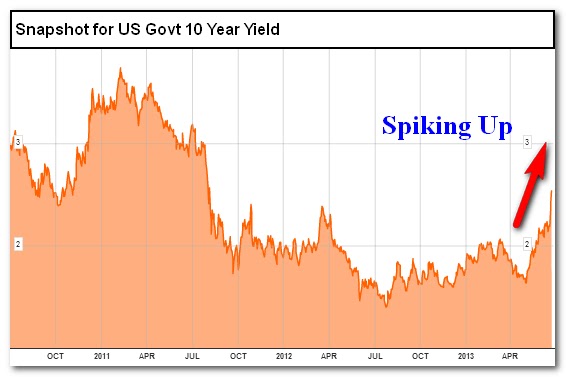
Just when the whole world coming for a rout, only US treasury yields shoot up to multi-months high. Investors might wondering why this happen. Some of our readers are posting these kind of question to us. We think this article might helps.


US Treasury = US Government Bond

Actually, we are referring to US Government 10 Years Bond. Generally, a government bond is issued by a national government (in this case US) and is denominated in the country's own currency (USD). Bonds issued by national government in foreign currencies are normally referred to as sovereign bonds. The yield required by investors to loan funds to governments reflects inflation expectations and the likelihood that the debt will be repaid.

Also, government bonds were usually referred to as risk-free bonds, because governments could easily devalue their currencies or raise taxes to redeem the bond at maturity. 


The Story of US Treasury Yields...
Just like Base-Lending-Rate (BLR) for Malaysia, everything from mortgages to corporate loans in US depends on US treasury yields. Higher yields mean higher borrowing costs. To stimulate the US economy, Federal Reserve had came out with various Quantitative Easing (QE) actions to bring down the said yields, allowing borrowers access to cheap funding. How to bring down yields? Federal Reserve will buy back US treasuries, thus, flooding the market with money. The side effect was a weakening USD.


However, all things will change 360 degree, if Federal Reserve start to slow down or totally stop their so called QE3. This is what happening now, creating uncertainties to global markets.

17 Haziran 2013 Pazartesi

The Rise of Financial Planner

As promised, Finance Malaysia blog would like to educate public at large on the importance of personal financial planning after knowing that most Malaysians falls into debt traps because of poor financial planning. After finding out, we're surprised that actually not many of us know that there is this NEW distribution channel in financial place --- Financial Planner.


The NEW Alternative...

Traditionally, when we looking for certain financial products or services, normally we will go to either agents or banks. Example, for life insurance or unit trust, we buy from life insurance agent or unit trust consultant or banker.

This trend continues for so many years back then until Securities Commission of Malaysia and Bank Negara Malaysia comes out a framework or guidelines introducing financial planning industry in year 2007. Then, financial planning firms emerge in the market place. Of course, financial advisor/planner came into picture naturally.

Role of a Financial Planner?
By definition, a financial planner is a practicing professional who covers the whole process of financial planning including cash flow management, education planning, risk management, investment planning, retirement planning, estate planning, tax planning and business succession planning (for business owners). The key defining aspect of what the financial planner does is that he/she considers all questions, information and advice as it impacts the financial situation of client. 

Highly Regulated?
In Malaysia, the term 'financial planner' was highly regulated and legislation was in place requiring a person to be licensed before he/she can call himself/herself as 'financial planner'. Authorities view financial planner as a professional and such title could differentiate them from the rest of financial practitioners. Same goes to titles like 'Dr' only for Doctor or doctorate graduates, and 'Ir' for qualified professional engineers to instill the confidence of public based on titles and qualifications.

It's an offence to call on yourself as a financial planner or practicing financial planning for clients, if without license in Malaysia. Those who found with such offence, on conviction, be liable to fine not exceeding RM5mil or imprisonment not exceeding 5 years term or to both. Wow... it's as a serious offence.

Even said so, many insurance agents or unit trust consultants committed the offence without realizing it. So, please tell your insurance agent or unit trust consultants whom you love or care about.

This article was contributed by Alex Yeoh, a licensed financial planner with a reputable financial planning firm. Finance Malaysia blog will work together with Alex in bringing more interesting articles on personal financial planning. For more info, you may reach him via email alexyeoh@vka.com.my

14 Haziran 2013 Cuma

Why so FEAR if US Federal Reserve stop QE ?

Global shares tumbles to multi-months low, especially in Asia whom did well year-to-date thanks to Japan's Abenomics. Commodities and gold also can't spare from the bearish sentiment across investment markets. Reason? US Federal Reserve may stop/scaling down their bond-purchase program. Huh!!!


Is this the real reason?
Like what I always said, analysts always give a reason for whatever bull or bear markets (after it had happen). For me, the main reason was (again) profit-taking activities took place in view of the good performances during first half of this year.


How about Federal Reserve's QE ?
It's funny to blame Federal Reserve for the corrections. First, why Fed want to stop QE at the first place? It's because US economy is recovering well. Wasn't this a good news to global markets? Definitely. Then, why we're so fear if Fed stop QE ? Doesn't make sense, right?


Anyway, like what I said, the real reason was profit-taking activities which is normal after a good run-up. Current stage must took place before the market can move higher. Good for investors. Good for you. Good luck.