bond etiketine sahip kayıtlar gösteriliyor. Tüm kayıtları göster

19 Haziran 2014 Perşembe

TA Regular Income Fund

In an ever-changing world, TA Investment Management Berhad are proud to announce to you the launch of TA Regular Income Fund. IOP starts from 16 June - 30 July 2014. 


Reasons not to miss this investment opportunities:


Awards Winning Fund Manager - Fullerton Fund Management:

a) Winner of the Singapore Lipper Fund Awards 2014 – Best Bond Singapore Dollar (3 Years) for Fullerton Short Term Interest Rate Fund
b) Winner of Asian Private Banker Asset Management Awards for Excellence 2013 - Best Fund House for RMB Denominated Bonds
c) Winner of Morningstar Fund Awards (Singapore) 2010 for Asian Bond
d) Winner of the below awards as voted by “The Asset” magazine, for their flagship Fullerton 


Highly recognized fixed income manager in Singapore: 
- Fullerton currently have two flagship SGD fixed income funds in Singapore. Both of the funds have AUM of more than S$1bn each. Hardly fixed income funds in Singapore will have more than S$1bn AUM.


Note: Fullerton Fund Management has an excellent track record with no history of loss from bond default. 


Mitigate the possibility occurrence of mismatch risk and ensure the Fund potentially obtain the full notional value of those bonds upon the Maturity Date of the Fund

- No perpetual bond. 
- Avoid trading on bonds. 
- Invest in bonds that match the Maturity Date of the Fund.


Note: **This is not a capital protected/ guaranteed fund and the returns are not guaranteed. Capital investment and capital preservation is subject to no default of underlying bonds or fixed income securities. 


Source: TA Investment Management

6 Temmuz 2013 Cumartesi

New Fund: Eastspring Investments Target Income Fund 2

In the current low interest rate environment, investors continue to chase for yields which resulted in strong demand for close-ended bond funds that potentially offers higher return than fixed deposits. Keeping this in mind, Eastspring Investments is launching a new fund.


The fund endeavors to provide regular income during the tenure of the fund (3 years), by investing in local and/or foreign debt securities.

Investment Strategy
A minimum of 70% will be invested in local and/or foreign debt securities, while the remaining of not more than 40% may be invested either in non-rated debt securities and/or debt securities rated below investment grade rating.

  • lower than BBB3 rating by RAM; or
  • below investment grade rating by other rating agencies

Although the fund is expected to invest up to 40% in non-rated issuers and/or issuers rated below investment grade, there is a risk that this limit may be exceeded as issuers of investment grade debt securities held within the portfolio may be downgraded by rating agencies and thus resulting in the fund's over exposure in such category.


Additionally, up to 30% may invested in money market instruments, and worth to note that the fund may exercise Early Repayment. As such, this is a moderate risk fund, instead of low risk.

The fund is suitable for investors who:-

  • seek regular income distribution;
  • have 3 years investment horizon; and
  • have a moderate risk tolerance.


24 Haziran 2013 Pazartesi

Understanding US Treasury & Yields


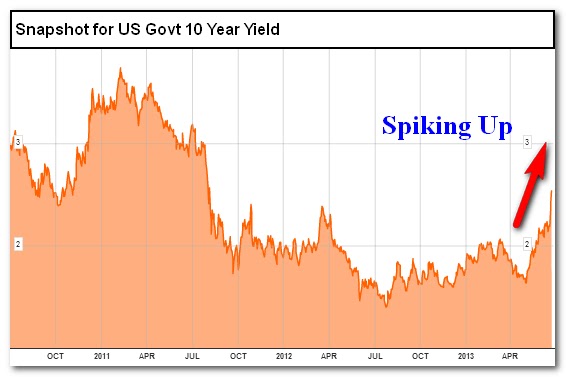
Just when the whole world coming for a rout, only US treasury yields shoot up to multi-months high. Investors might wondering why this happen. Some of our readers are posting these kind of question to us. We think this article might helps.


US Treasury = US Government Bond

Actually, we are referring to US Government 10 Years Bond. Generally, a government bond is issued by a national government (in this case US) and is denominated in the country's own currency (USD). Bonds issued by national government in foreign currencies are normally referred to as sovereign bonds. The yield required by investors to loan funds to governments reflects inflation expectations and the likelihood that the debt will be repaid.

Also, government bonds were usually referred to as risk-free bonds, because governments could easily devalue their currencies or raise taxes to redeem the bond at maturity. 


The Story of US Treasury Yields...
Just like Base-Lending-Rate (BLR) for Malaysia, everything from mortgages to corporate loans in US depends on US treasury yields. Higher yields mean higher borrowing costs. To stimulate the US economy, Federal Reserve had came out with various Quantitative Easing (QE) actions to bring down the said yields, allowing borrowers access to cheap funding. How to bring down yields? Federal Reserve will buy back US treasuries, thus, flooding the market with money. The side effect was a weakening USD.


However, all things will change 360 degree, if Federal Reserve start to slow down or totally stop their so called QE3. This is what happening now, creating uncertainties to global markets.

23 Şubat 2013 Cumartesi

New Fund: CIMB-Principal Enhanced Opportunity Bond Fund


They say that the only constant in life is 'change'. Well, not always. Hopefully, with this new fund, you will find comfort in its stability. Furthermore, it aims to provide more returns than the current Fixed Deposit rate, and is more stable than equities. Riding on the growth of the Asian countries, investors have the opportunity to diversity their portfolio and increase the returns. This fund is only available until 4 April 2013 !


What is CIMB-Principal Enhanced Opportunity Bond Fund?
It is a close-ended fund that aims to provide investors with total return through investments in a portfolio of debt securities primarily in bonds. The fund seeks to achieve its overall objective by providing total returns consisting of a combination of interest income and capital appreciation. 


Investment Strategy

Under general market conditions, between 70% to 99% (both inclusive) of the Fund’s net asset value (“NAV”) will be invested in non-ringgit debt securities primarily in bonds (including convertible bonds). Of the 99%, up to 40% of its NAV may be invested in unrated securities and high yield securities respectively while the remainder will be invested in investment grade securities. These investment grade securities are issued or backed by governments, government agencies, supranational organizations, corporate or other issuers. At least 1% of the Fund’s NAV will be maintained in the form of liquid assets such as bank deposits for liquidity purpose.

However, in the event of limited non-ringgit debt securities, the fund manager will have the discretion to invest in the ringgit debt securities primarily in bonds with yield at the prevailing market condition, if the fund manager is of the opinion that by doing so is in the best interest of the Fund.


While the Manager intends to adopt a buy-and-hold strategy for the Fund whereby the securities purchased will be held for the tenure of the Fund or to maturity of the securities,
the Manager reserves the right to deal with the securities in the best interest of the Unit holders in the event of a credit rating downgrade.


The Fund is suitable for investors who have three (3) years investment goals and are not planning to have access to their money in the next three (3) years. It is also suitable for investors who are seeking exposure to investment opportunities in debt securities.


Source: Fund prospectus

21 Ocak 2013 Pazartesi

CLSA Malaysia Politics Market Strategy

There is no better time to blog about this post. After the plunge of KLCI yesterday, citing election risk, we came across an interesting research report by CLSA. As such, we would like to take this opportunity to share with you.


By CLSA,

An unexpected opposition Pakatan Rakyat (PR) coalition victory in the impending 13th General Election (13GE) would spark a broad sell-off in Ringgit assets. Changes of government are not uncommon in ASEAN. Looking at the experience of Indonesia, Thailand and the Philippines over the last decade, parliamentary control has seen significant shifts and governance has been possible despite the lack of a parliamentary majority. However, Malaysia has never experienced a change in government, meaning any change will come as a shock and with a host of uncertainties.


From an equity and debt market perspective, Malaysia has always enjoyed a political premium for the stability in governance and policy-setting stemming from majority control of parliament. The immediate financial market repercussions can be grouped as follows:

  • Equity and bond markets sell-offs are likely as Malaysia's political stability premium is erased, at least temporarily. Domestic corporate, many of which have deep links with the existing government, will be putting big-ticket decisions on hold pending guidance on continuity;
  • Ringgit depreciation can be expected in parallel with the sell-off in Malaysian assets by foreign investors. This will pose another drag on broad corporate and foreign investor confidence, especially foreign debt (though positive impact on exporters should not be forgotten).
  • And, subsequently draw unfavorable attention from international rating agencies.


Near-term policy expectations

  • PR's stated policies are broadly aimed at raising disposable incomes, improving fiscal governance (key revenue generator), and encouraging private investment.
  • Higher minimum wage and lower car prices will support consumer spending, while cutting ASEAN-topping corporate tax rate would reassure corporate and investors.
  • State oil company Petronas will get more resources to invest in rebuilding reserves.

Medium-long term policy focus

  • PR's desire to "rebalance" government contracts and agreements means negative overhangs for state-dependent entities i.e. utilities, concessionaires, construction.
  • Banks as large holders of private sector bonds will face negative risk perception.
  • Reversing GLC dominance (Iskandar not impacted) will boost private investment and FDI; Khazanah could accelerate local asset disposals, lifting Bursa's free-float.


"Rain or Shine" stock picks

  • At the macro level, companies with government-dependent contracts, licenses and concessions will see sustained negative overhang and discounting, while consumer and oil & gas sectors will benefit from rising disposable income and Petronas capex.
  • Our "rain or shine" stock picks are expected to do well under either a BN or PR-led government, with earnings underpinned by higher disposable incomes, Petronas association, overseas earnings contribution buffer and a weaker currency.
  • A market sell-off would be a prime opportunity to add to positions in Axiata, PGas, UEM Land, IHH, Sapura Kencana, AirAsia and exporters e.g. rubber glove players.


Source: CLSA Asia-Pacific

8 Ocak 2013 Salı

Understanding Exchange Traded Bond and Sukuk (ETBS)

Today, Malaysia achieve its first milestone in Exchange Traded Sukuk, following the launching of RM300million sukuk by DanaInfra Nasional Bhd. This is the first sukuk for retail investors. When we mention about retail investors, which refer to public, are we ready for this kind of new investment? We should better understand first before jumping onto the ship...


In short, ETBS refers to Exchanged Traded Bond and Sukuk. Generally, bonds/sukuk have always been seen as an asset class to hedge when markets are bearish and a means to develop a steady income over many years. But in the past, these was only accessible to high net worth and institutional investors. Now, with ETBS, all investors can have access to the bond/sukuk market with ease, via the stock market.

What are ETBS ?
ETBS are fixed income securities, also known as bonds or sukuk (syariah compliant bond), that are listed and traded on the stock market. ETBS are issued either by companies or governments (the issuer) to raise funds for their needs. ETBS have varying structures such as fixed rate, floating rate and hybrids.

Why Invest in ETBS ?
Here are some of the reasons to invest in ETBS:

  1. Flexibility and ease of trading on Bursa Malaysia
  2. Transparency, as ETBS are listed on the bourse, investors will have access to real-time prices and volumes, just like shares, with up-to-date information.
  3. Diversification by including ETBS in your portfolio, to complement your investments in other asset classes.
  4. Additional income stream, from the steady income stream through regular coupon payments.


What are the Factors that determine the price of an ETBS ?

  1. Price and Yield
    • It's all about demand and supply in the marketplace. High price, low yield. Low price, high yield. Since the coupon payments for an ETBS are generally fixed to the principal value of the bond, what you pay (price) is crucial to determine the yield.

  2. Interest Rates
    • ETBS is sensitive to interest rates changes. Supposing the average interest rate available to investors goes up, the ETBS' current yield will become a less attractive investment. This would caused a decline in the price of ETBS; until when the yield becomes competitive with prevailing rates. The reverse occurs, if interest rates go down.

  3. Credit Risk
    • Essentially, credit risk is the likelihood that the issuing entity will or will not be able to repay principal amount and its interest element at maturity. As such, corporate ETBS has higher risk than most government ETBS. It was evaluated and rated by rating agencies, such as MARC, RAM, Moody's and S&P. A top rating (AAA) means the ETBS carries the least credit risk (not without risk). Ratings can be upgraded or downgraded, thus, affecting the price.

  4. Maturity
    • Longer maturities have more risk and tend to priced lower (or have higher yields), because of uncertainties in future. Eventually when ETBS start to approach their maturity date, their prices start to get close to the par value.

Please take note that the minimum board lot size for ETBS is 10 units, versus 100 units for shares. You can start trading ETBS simply by opening a CDS account, just like share trading. Happy trading!!!


Source: Bursa Malaysia

7 Aralık 2012 Cuma

New Fund: OSK-UOB Multi Asset Regular Income Fund

As investor continue to seek safe investment havens, i.e. investments that are more stable and/or of lower risk and with regular income, OSK-UOB Investment Management see opportunities in the Asia and Asia Pacific (ex Japan) region. Hence, they are now offering investors a fund that utilizes a multi-asset strategy to generate potential regular income and capital growth in a fund that invests in three yielding assets i.e. bonds, equities and REITs (real estate investment trusts) from the Asia and Asia Pacific (ex Japan) region.


The Fund is suitable for investors who:

  1. seek regular income and capital growth over medium to long term;
  2. are willing to accept moderate risk in their investments; and
  3. wish to benefit from investment exposure in the Asian and Asia Pacific (ex Japan) region.
Tactical Asset Allocation?
Of the fund's investments, the External Investment Manager will initially invest in accordance to the allocation stated in the table below. However, for the purpose of tactical asset allocation, the manager may deviate from the stated allocation by a 10% variance for each asset class depending on the market conditions to achieve medium to long term returns.


Thus, this Fund's portfolio will be structured as follows:
  • 65% - 98% of NAV
    • Investments in Asian (ex Japan) debt instruments / bonds, Asia Pacific (ex Japan) dividend equities and Asia Pacific (ex Japan) REITs.
  • 2% - 35% of NAV
    • Investments in liquid assets including money market instruments and deposits with financial institutions.
What's the composite benchmark for this fund?
  • 50% JP Morgan Asia Credit Index Total Return Composite (RM);
  • 30% MSCI AC Asia Pacific ex Japan Index (RM);
  • 20% MSCI AC Asia Pacific ex Japan REITs Index (RM).
Distribution Policy:
Depending on the level of income generated at each relevant period, the fund will declare distributions, if any, to unit holders QUARTERLY.


Source: OSK-UOB Investment Management

29 Ekim 2012 Pazartesi

New Fund: AmTactical Bond

Still remember one fund called AmDynamic Bond fund? If yes, you definitely knew the superb performance of that bond fund, which had became the flagship fund for AmMutual for past years. However, it was sad that, since few months ago, no more subscription was being allowed for AmDynamic Bond fund because it has reached the maximum limit set by regulators. In other words, too hot the demand for that fund. Then how?


Because of that reason, AmMutual is proud to launch another new fund, AmTactical Bond fund, which was managed by using the same strategy, but with a little bit more flexibility. The Fund aims to provide income and to a lesser extent capital appreciation by investing primarily in bonds.

How Flexible is it?

The Fund seeks to achieve its objective by investing primarily in sovereign, quasi-sovereign and corporate bonds including convertible bonds. There is NO minimum rating for a security purchased or held by the Fund.


To construct the portfolio of the Fund, the Investment Manager will analyse the general economic and market conditions. The Investment Manager will also analyse and compare securities in terms of expected returns against assumed risk by analyzing credit rating and duration of the securities, where the Investment Manager will select securities that will deliver better returns for a given level of risk. In addition, the Investment Manager may also consider securities with a more favorable or improving credit or industry outlook that provide potential capital appreciation. The Fund’s investment is subject to active tactical duration management, where duration of the Fund will be monitored and modified according to interest rate outlook without any portfolio maturity limitation.


Asset Allocation


  • 70% - 98% invested in bonds;
  • 0% - 28% invested in other permitted investments; and
  • a minimum of 2% will be invested in Liquid Assets.


AmTactical Bond is suitable for investors who:


  • are willing to assume risks associated with investing in securities with long duration (i.e. there will be no portfolio maturity limitation) and low credit ratings (i.e. there will be no minimum rating for the securities purchased or held by the Fund); and
  • have an investment horizon of more than three (3) years.


Source: AmMutual

15 Ekim 2012 Pazartesi

New Fund: TA Total Return Fixed Income Fund

Just another new fund from TA Investment Management (TAIM)? Think again... In fact, this is the first bond fund launched by TAIM and it will take on the other bond funds in the market with a "Wow" effect. Why? Believe me, you gonna put this fund into your radar of unit trust investment. And, you will know why after reading this post.


The TA Total Return Fixed Income Fund is a feeder fund which invests a minimum of 95% of its NAV into the PIMCO Funds: Global Investors Series plc - Total Return Bond Fund (SGD Hedged) and the balance in liquid assets. What? PIMCO !!! Yup, it's the leading global investment management firm, especially on fixed income investment.

5 Reasons Why you should invest into this Fund?

  1. Total Return Strategies, Global Diversification & Flexibility
    It aims to maximize the total return, consistent with preservation of capital and prudent investment management by investing 2/3 of its assets in a diversified portfolio of fixed income instruments of varying maturities.

  2. Higher Potential Returns at Lower Risk
    The core bond investment fund is broadly diversified to include all fixed income asset classes. Target fund is 90%-100% invested in investment grade bonds.

  3. Proven Consistent Track Record
    The Target fund has recorded consistent and positive annual returns since launch, even amid the prolonged crises across the globe.

  4. High Recognition
    Superbly high ratings have been assigned by independent investment research providers, such as Morningstar, Lipper and S&P.

  5. Expert Management --- PIMCO
    Once again, it was managed by PIMCO, has been investing money on behalf of a wide range clients including over 70% of Fortune 100 companies. PIMCO has a history of long-term performance in both bull and bear markets, with benchmark-like risk.

By investing into this fund, now you can leverage on the expertise of PIMCO to diversify your investment portfolio to include fixed income. It's superb track record already spoke for itself, in which we should rest assured with.


Source: Fund prospectus

7 Ekim 2012 Pazar

New Fund: AmIncome Flexi


In view of current uncertainties still lingering around investment universe, bond was considered as one of the asset class that most investors seeks to preserved their asset value, albeit lower risk. Just as the name of the fund, it's a flexible bond fund which has an interesting early repayment features. Let's have a look.


The Fund is a 3-year close-ended bond fund that aims to provide annual income distribution throughout the duration of the fund. To achieve the investment objective, the fund intends to invest its NAV in a portfolio of domestic and/or foreign sovereign issued bonds and corporate bonds.
  • Domestic bonds:
    --> minimum credit rating will be “A” rated by RAM or MARC’s equivalent. 
  • Foreign bonds:
    --> minimum credit rating will be “A” rated by their respective local credit rating agencies which denotes strong capacity to meet financial commitments and/or “BB” rated by S&P or Moody’s equivalent at the time of investment.

As this is a close-ended fund, the Investment Manager will purchase bonds which will be held until its respective maturity. These bonds will generally have shorter or similar maturity tenure to the Fund’s maturity. The Fund employs a flexible investment strategy as follows:-

  1. The Investment Manager will not actively adopt a trading strategy unless there are changes or expected changes in interest rates resulting in bond price changes, for the purpose of maximizing returns of the Fund over the Fund’s tenure of three (3) years;
  2. The Investment Manager may also at its discretion dispose off a bond to mitigate currency risk for the benefit of the Fund; and
  3. The Investment Manager may also opt to dispose off a bond when it has achieved at least 15% cumulative return before its maturity, and return the proceeds of the bond (which includes principal and realised gains such as coupons received, capital gains and currency gains) to the investors.


In the event of a credit downgrade, the Investment Manager may liquidate the particular bond affected if the Investment Manager at its discretion feels that there is a likelihood of credit default. Changes in credit rating will have no impact upon the price of the bond at maturity. However, if the Investment Manager chooses to sell the bond prior to the bond’s maturity, it may result in a capital loss and this will be borne by investors of the Fund. A credit downgrade means that credit risk is increased but does not constitute default.

The Fund may be investing in countries where the regulatory authority is a member of the International Organisation of Securities Commission (IOSCO) which include but not limited to Malaysia, Australia, New Zealand, Korea, Hong Kong, Singapore, Philippines, Indonesia and Thailand. As the Fund may invest in foreign currencies denominated bond, the Investment Manager may use derivatives for currency hedging purpose.


Early Repayment Mechanism?

When a bond held in the Fund has achieved 15% cumulative return at any time before its maturity, the Investment Manager may sell down the bond and realize the gains. The proceeds of the bond (which includes principal and realised gains such as coupons received, capital gains and currency gains) will be returned to the investors. In this respect, NAV of the Fund will be reduced accordingly and the units of the Fund will be adjusted according to the proportion of that bond in the Fund. This will result in Unit Holders holding lesser units after Early Repayment. In the case of Early Repayment, there will be no adjustments to NAV per unit of the Fund.


The Fund is suitable for investors who seek:

  • an investment that provides regular income and potentially higher returns than the 1-year AmBank (M) Berhad Conventional Fixed Deposit Rate (fixed as at Commencement Date); and
  • an investment that provides lower risk than equities.


Source: AmMutual


fff

29 Eylül 2012 Cumartesi

Budget 2013: Election or Rakyat centric?

General election is around the corner. External environment was not so promising, following the no ending of European debt crisis, world economic slowdown, and recent tension between China and Japan. I believe all of these would be some key factors being taking into consideration to formulate the Malaysia Budget 2013.


Goodies? Bonus? Cash handout?
Themed as "Prospering The Nation, Enhancing Well-Being of the Rakyat: A Promise Fulfilled". Our prime minister, who is also Finance Minister, tabled the 2013 Budget at Dewan Rakyat yesterday. Over here, Finance Malaysia blog would only touches on some key points:
  • Economic growth projected to expand between 4.5% - 5.5%
  • Federal Government's revenue in 2013 is estimated to increase to RM208.6 billion
  • Continuation of BR1M of RM500 to households earning not more than RM3,000 a month and also extended the aid to cover a payment of RM250 for single unmarried individuals aged 21 and above, earnings not more than RM2,000 a month
  • RM 16 million a year group insurance scheme for registered hawkers and small businesses for coverage of up to RM5,000
    • FM: Once again goodies were dished out to created a feel-good factor for govt and we doubted whether Msia could achieves the 4% budget deficit target in 2013. Anyway, govt could still succeed by increasing the revenue by using these goodies. How? Very simple, that's to entice the non-registered self-employed and businesses to registered so that they are accountable for their earnings.


Spurring retail bond/sukuk market:
  • DanaInfra Nasional Bhd to issue retail bonds worth RM300million by end-2012 to finance MRT development projects
  • Additional expenses incurred in issuance of retail bonds and retail sukuk to be given double deduction for a period of 4 years from YA2012 to YA2015
  • Individuals investors given stamp duty exemption on instruments relating to transactions of retail bonds and retail sukuk
    • FM: It's very clear and straight forward that the govt want to see the soon-to-be launched retail bond/sukuk market to prosper, thus, attracting more foreign funds to the country to make it more vibrant and liquid.
Youth-centric offers:
  • A one-off rebate of RM200 for the purchase of one unit of 3G smartphone from authorized dealers for youths aged between 21 to 30 years old with monthly income of RM3,000 and below.
  • PTPTN loans: 20% discount for full repayment of loan; 10% discount for regular repayment.
  • RM250 1Malaysia book voucher for students studying at institutions of higher learning
    • FM: It seems too good to be true for PTPTN borrowers. But, it was attractive for probably 1% of them only. Why? We must remember that they borrow because they doesn't have money in the first place, not because they want to leverage. Do you get my meaning? Or, does govt scared if opposition coalition will void all outstanding loans if they took over?
Addressing the skyrocketing property prices:
  • RM500 million by PR1MA to build 80,000 houses in major locations nationwide with selling price ranging between RM100,000 and RM400,000 per unit. Among the locations are KL, Shah Alam, JB, Seremban and Kuantan.
  • MyFirst Home Scheme will be enhanced by increasing the income limit for individual loans from RM3,000 to RM5,000 per month or joint loans of husband and wife of up to RM10,000 per month.
  • Real Property Gains Tax (RPGT) for properties disposed within 2 years will be taxed at 15% (up from 10%) and 10% for between 3rd to 5th year (up from 5%), whereas other term remained unchanged.
    • FM: For us, we think that 15% RPGT is still too low if compared to pre-2007, where RPGT for first 2 years disposal was as high as 30% and 25%. Meanwhile, MyFirst Home Scheme was very tough to get it, as far as we concerned. Once again, good luck to those potential property buyers.
Changes to personal income tax:
  • Individual income tax rate to be reduced by 1% for each grouped annual income tax exceeding RM2,500 and RM50,000.
  • Tax relief on children's higher education scheme (SPNN) increased to RM6,000 per person (from RM4,000 previously).
    • FM: The 1% tax reduction seems more effective to help out those mid-income earners, although it's not much. However, we are disappointed once again for the unchanged REITs withholding tax structure which makes M-REITs less attractive compared to regional REITs.
Government servants is the BIG winner AGAIN!!!
  • Minimum pension to be increased to RM820 for those who had served the govt for at least 25 years. More than 50,000 pensioners benefited.
  • 1.5 months bonus for civil servants.
    • FM: Well... Nothing much we can say about it. This is a govt budget. What's wrong if govt servants being the beneficiary? But, should it be again and again? Hmmm...

"Stocks-to-watch" for the coming Monday:
  • Genting, GENM, JTI, BAT on the surprise unchanged sin taxes
  • Construction companies on the River of Life projects, EPP projects and schools upgrade
  • Consumer related players on the expected extra spending by govt servants with bonuses
  • Low cost housing developers (etc. Hua Yang) for possible contracts by PR1MA
  • Financial institutions with investment banking arm for the launching of retail bond/sukuk market

12 Eylül 2012 Çarşamba

New Fund: OSK-UOB Focus Bond Fund - Enhanced


In view of the current volatile markets culminating from the Eurozone debt crisis, investors are concern about the contagion effect on the domestic and global economies. Amid the recent volatility, some believe there are opportunities arising from bond investments that will offer consistent and regular income to investors. Hence, OSK-UOB now offer investors an enhanced bond fund that has the potential to provide higher regular income^ during the tenure of the Fund and capital appreciation at its maturity date from a concentrated portfolio of global debt instruments / bonds and from an option structure to provide the potentially higher income.


The OSK-UOB Focus Bond Fund – Enhanced (“the Fund”) is a 3-year close-ended, income fund which aims to provide regular income during the tenure of the Fund and capital appreciation at its maturity date primarily from a concentrated portfolio of global debt instruments / bonds. Generally, the Fund aims to achieve its objective through a two-fold strategy.


  1. Fixed Income portionThe first is to invest in a concentrated portfolio of fixed income securities to provide a stable income stream. In managing the fixed income portfolio of the Fund, the External Investment Manager will generally seek out global debt instruments / bonds that are able to offer attractive yields (i.e. yields that are greater than the Fund’s benchmark net of expenses) and/or capital appreciation during the tenure of the Fund. Given the Fund’s 3-year tenure, the External Investment Manager will invest in a concentrated portfolio of not more than 20 global debt instruments / bonds to lock-in the yield.
  2. Option portionThe Fund will also invest in a 3-year OTC call option that is referenced to a yield enhancement strategy(YES). The YES Option is denominated in Singapore Dollar (SGD) and the Fund will have 150% Participation Rate in the YES Option’s annual returns. As the tenure of the Fund is 3 years, the YES Option is designed to provide 3 annual coupon payments during the 3 years tenure of the YES Option. As such, there will be 3 observation periods for the determination of the performance of the YES Option (i.e. the 3 annual coupon payments).


Its indicative asset allocation is as follows:
  • 92% - 100% of Net Asset Value- Investments in global debt instruments/bonds.
  • Up to 3% of Net Asset Value- Investments in the YES Option.
  • Up to 5% of Net Asset Value- Investments in liquid assets including money market instruments and deposits with financial institutions.
^Note: The income (if any) is in the form of cheque payments.


Source: OSK-UOB Investment Management

17 Ağustos 2012 Cuma

New Fund: AmGlobal Sukuk

After AmMutual's asia pacific dividend fund early this month, AmIslamic also don't want to lag behind its sister company by introducing AmGlobal Sukuk. The Fund aims to provide capital appreciation by investing primarily in Sukuk both locally and globally.


To achieve the investment objective, the Fund will undertake active management to enhance and optimize returns from investing in sovereign, quasi-sovereign and corporate Sukuk. The sectorial weightings may be adjusted to maximize the performance. There is no minimum rating for a Sukuk purchased or held by the Fund.

What's so special about this Sukuk Fund?

Value-add of the Fund is derived from active tactical duration management, yield curve positioning and credit spread arbitrage. Credit spread arbitrage and yield curve positioning is part of relative value approach that involves analysis of general economic and market conditions and the use of models to analyze and compare expected returns as well as the assumed risks. The Investment Manager will focus on Sukuk that would deliver favourable return in light of the calculated risks.

In addition, the Investment Manager may also consider Sukuk with favourable or improving credit outlook that provide the potential for capital appreciation for these investments. The Fund may invest in Sukuk of varying maturities. The Fund’s investment maturity profile is subject to active tactical duration management in view of the interest rate scenario without any portfolio maturity limitation.


AmGlobal Sukuk is suitable for investors who :
  • want steady growth in value by investing in Sukuk as an asset class;
  • have Medium to Long Term investment goals; and
  • are willing to assume additional risk associated with investing in Sukuk with longer duration and lower credit ratings.
Source: AmIslamic Funds Management
Click here to download the fund prospectus