equity etiketine sahip kayıtlar gösteriliyor. Tüm kayıtları göster

4 Ağustos 2015 Salı

New Fund: Public Select Treasures Equity Fund

Yet, another new fund from Public Mutual for investors to consider. The local fund house want to capitalize on its local expertise by launching this new local fund which seeks to achieve capital growth over the medium to long-term period by investing in a portfolio of investments comprising small and medium-sized companies in terms of market capitalisation from diversified economic sectors.


Only local? How about foreign markets?
Although the fund is predominantly investing in local stock market, it can also invest in component stocks of small and mid cap stock market indices of selected foreign markets. If the small and mid cap stock market indices are not available for a foreign market, the fund will invest in stocks of companies which form the bottom 30% of the cumulative market capitalisation of that particular market.

To achieve increased diversification, the fund may invest up to 25% of its NAV in equities and fixed income securities of selected foreign markets which include China, South Korea, Japan, Taiwan, Hong Kong, Singapore, Indonesia, Thailand, Philippines and other permitted markets.


Does the fund do currency hedging?
Yes, the fund may utilise foreign exchange forward contracts to hedge against foreign currency movements.


What's the benchmark the fund?
  • 70% FTSE Bursa Malaysia Mid 70 Index;
  • 20% FTSE Bursa Malaysia Small Cap Index; and
  • 10% 3-Month KLIBOR


Source: Public Mutual

7 Ağustos 2014 Perşembe

Understanding "Special Purpose Acquisition Company" (SPAC). Is it Purely Speculative?

After almost 3 years since the listing of Malaysia's first special purpose acquisition company (SPAC) on Bursa Malaysia, many investors still don't know what's that and many investors skeptical about its existence. Let's us explore here...


What's SPAC ?

It's another product of Bursa Malaysia, which is very different from other trading companies or products on the stock exchange. Before investing into a company, what do we consider first? Company profits track record? Business model? Earnings growth projections? P/E ratio?... All of these info is UNAVAILABLE for SPACs during initial public offering (IPO).

In fact, a SPAC is floated without any business. It's up to the management to identify a suitable acquisition or merger (or more), and to secure shareholder approval to use IPO proceeds to pay for that deal. In Malaysia, a SPAC must complete at least a deal within 3 years after listing.

Without all those info, what could investors relying to? Obviously, the only visible reference was their management team. The success of a SPAC depends solely on the management team, which basically comprise of experience or expertise people to conclude a deal.

Then, this is very risky. Correct?
Undeniably, it's riskier than ordinary IPO investment. In order to safeguard investors interest and providing them some comfort, SC guidelines stated the following 2 key rules for SPAC:


  1. 90% of the IPO proceeds raised must be placed into a trust account, and
  2. If the SPAC fails to make a deal after the 3 years deadline, it will be liquidated and the trust money will be distributed to shareholders.

So, is it worth to invest in?
Yup. SPAC was very much like a speculative investing, without any fundamentals of a proper business in place. It solely depends on the management team to make it or break it. With the 3 year deadline, this puts SPAC in a dire needs to conclude a deal than the seller. This may adversely affecting the negotiation power of SPAC. Do you think that the deal negotiated in such manner could bring advantages to shareholder? Let's wait and see...

25 Temmuz 2013 Perşembe

New Fund: Kenanga Asia Pacific Total Return


After merging with ING Funds Berhad, Kenanga Investors Berhad launched its first new fund of the enlarged family. In this uncertain global economic environment, how much return can a fund generated was the main concern for many investors. Want to get higher return? Then, we cannot runaway from higher volatility! Are there any balance in between?


Yes. To cater for such investors, this new fund aims to provide a compounded rate of return of at least 10% per annum over market cycle (5 years) by investing in a diversified portfolio of Asia Pacific equities.


3 Reasons WHY it benefits you:


Well... Unlike others, this fund DO NOT has any benchmark constraint. This allows flexibility in identifying and implementing the most optimum investment strategy. Picture below shows the differences between Absolute and Relative return:

Still not yet convinced? How about the proven track record?


Source: Kenanga Investors Bhd

12 Mart 2013 Salı

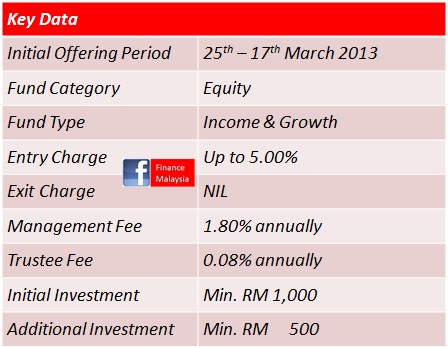
New Fund: AmAsia Pacific Leisure Dividend

Do you like to go on a holiday spree in Asia Pacific region? If yes, then this fund may suit your appetite. On top of that, you can expect some dividends from this new fund launched by AmMutual. Please read on.


The fund aims to provide regular income and to a lesser extent capital appreciation over the medium to long term by investing in equities and equity-related securities of leisure industry across Asia Pacific region.


To achieve its objective, the fund seeks will be investing 70%-98% in a diversified portfolio of equities related to leisure industry. Who were they? They may include issuers engaged in the design, production and distribution of products and services related to leisure industry. These companies operate in the following sectors within the leisure industry such as hotel, retail, publishing, advertising, beverages, audio/video, broadcasting radio/television, cable and satellite, motion picture, recreation services and entertainment, toy, gaming and tobacco.

Where were they?

These companies are listed in the Asia Pacific region, which includes but not limited to Australia, Hong Kong, Malaysia, New Zealand, Singapore, South Korea, Taiwan and Thailand. However, the fund will not invest into Japan.


Investment Strategy...

The investment manager combines top-down asset allocation process with a bottom-up security selection process. The asset allocation will be reviewed periodically depending on the macroeconomic, industry trends, respective country's economic and stock market outlook. The asset allocation decision is made after a review of macroeconomic trends in Asia Pacific economies. As for bottom-up security selection, the investment manager will focus on undervalued companies which demonstrate sound corporate fundamentals, which are expected to provide dividends yield above market average, and sustainable dividend yield on a medium to long term basis. Stock valuation fundamentals considered are earnings per share growth rate, return on equity, price earnings ratio and price to book multiples.


Source: AmMutual

30 Ocak 2013 Çarşamba

NEW Aberdeen Islamic Funds

Aberdeen Islamic Asset Management Sdn Bhd has recently launched two shariah unit trust funds for the Malaysian market, the Aberdeen Islamic Malaysia Equity fund and the Aberdeen Islamic World Equity fund. The new funds are the company's 1st shariah retail products in Malaysia - and the 1st from a foreign fund manager under the special scheme - and come almost 8 years its parent company Aberdeen Asset Management Sdn Bhd was established to manage assets in Malaysia for institutions and corporate investors.


Malaysia: Turning promise into profit

Malaysia has long been rich in promise - rich because of its abundant natural resources, physical infrastructure and educated workforce. However it has not always maximize its advantages. In recent years that has changed as the country streamlines priorities. There is more emphasis now on efficiency, the private sector has a greater say across industries and more value is being created for shareholders. This enterprise is taking Malaysian companies overseas, too, helping businesses to sharpen their competitive edge.


Why Global then?
International markets are continually evolving, underpinned by increased movement of people, goods and capital around the world. But far from embracing 'globalization', research shows that investors tend to follow a home-country bias when it comes to their investments. As a result, they miss out on investments overseas that may offer steadier long-term returns as well as superior risk diversification.


Fund Detail
Source: Aberdeen Islamic Asset Management

7 Aralık 2012 Cuma

New Fund: OSK-UOB Multi Asset Regular Income Fund

As investor continue to seek safe investment havens, i.e. investments that are more stable and/or of lower risk and with regular income, OSK-UOB Investment Management see opportunities in the Asia and Asia Pacific (ex Japan) region. Hence, they are now offering investors a fund that utilizes a multi-asset strategy to generate potential regular income and capital growth in a fund that invests in three yielding assets i.e. bonds, equities and REITs (real estate investment trusts) from the Asia and Asia Pacific (ex Japan) region.


The Fund is suitable for investors who:

  1. seek regular income and capital growth over medium to long term;
  2. are willing to accept moderate risk in their investments; and
  3. wish to benefit from investment exposure in the Asian and Asia Pacific (ex Japan) region.
Tactical Asset Allocation?
Of the fund's investments, the External Investment Manager will initially invest in accordance to the allocation stated in the table below. However, for the purpose of tactical asset allocation, the manager may deviate from the stated allocation by a 10% variance for each asset class depending on the market conditions to achieve medium to long term returns.


Thus, this Fund's portfolio will be structured as follows:
  • 65% - 98% of NAV
    • Investments in Asian (ex Japan) debt instruments / bonds, Asia Pacific (ex Japan) dividend equities and Asia Pacific (ex Japan) REITs.
  • 2% - 35% of NAV
    • Investments in liquid assets including money market instruments and deposits with financial institutions.
What's the composite benchmark for this fund?
  • 50% JP Morgan Asia Credit Index Total Return Composite (RM);
  • 30% MSCI AC Asia Pacific ex Japan Index (RM);
  • 20% MSCI AC Asia Pacific ex Japan REITs Index (RM).
Distribution Policy:
Depending on the level of income generated at each relevant period, the fund will declare distributions, if any, to unit holders QUARTERLY.


Source: OSK-UOB Investment Management

8 Ekim 2012 Pazartesi

RHBRI Market Outlook & Strategy 4Q2012: Stormier Outlook


RHB research institute (RHBRI) is of the view that it could still be a choppy few months for the equity market in the 4Q given weakening economic fundamentals in the major world economies and fears of an imminent general election on the home front. Whilst more rounds of quantitative easing have been unveiled in the developed world, the big question in investors’ minds is how all these quantitative easing measures will translate to better global economic outlook. Having said that, equity still stands up vis-a-vis the unappealing returns of the alternative asset classes, such as cash and bonds and any good news is still likely to prompt a rally in equities.


How was Malaysia fared?
And, what's the strategy now?
Thus far, Malaysia has fared relatively well in the global financial crisis, and this is partly on account of low reliance on foreign funding of its banking system and more importantly, the progress in the implementation of the Economic Transformation Programme to boost domestic demand and cushion the economy against the downside risk from the external sector. As a result, the economy has bucked the trend and its real GDP growth is projected to pick up to +5.4% in 2013, from +5.0% estimated for 2012. This will translate to sustained earnings growth of around 6.0% in 2013 to create new shareholders’ values for investors.


We believe after a phase of correction and consolidation, the market will come back as the huge bond purchase programmes in the Eurozone and the US will push investors out of low-yielding cash and bonds over time into riskier assets such as equities. As the general election could be delayed to March 2013, our end-2012 FBM KLCI target remains unchanged at 1,690. Assuming global situations stabilize in six to nine months time and the global economic recovery is intact, our end-2013 FBM KLCI target is 1,815, based on 15x 2014 earnings.


Whilst our core strategy remains defensive, we believe investors would still need to accumulate fundamentally-robust stocks on weakness in order to outperform the market. In addition, as the search for yield will likely remain a key driver for both retail and institutional investors in the 4Q, high divided-yielding stocks will also continue to outperform the market, in our view. Sector-wise, our key overweight are telecommunications and banking, although we also have an overweight stance on the utilities and healthcare sectors.


Source: RHBRI research report

13 Ağustos 2012 Pazartesi

New Fund: CIMB Islamic Al-Azzam Equity Fund

Launched on the same day with AmMutual new fund, the CIMB Islamic Al-Azzam Equity Fund is an open-ended fund that aims to achieve consistent capital growth over the medium to long term.


The asset allocation strategy for this Fund is as follows: 

  • between 70% to 98% (both inclusive) of the Fund’s NAV will be invested in Shariah-compliant Malaysian equities; and 
  • up to 30% of the Fund’s NAV in other Shariah-compliant investments and Shariah-compliant liquid assets, with at least 2% of the Fund’s NAV to be maintained in Shariah-compliant liquid assets.


For this Fund, the investment into Sukuk must satisfy a minimum credit rating of “A3” or “P2” by RAM or equivalent rating by MARC; “BBB” by S&P or equivalent rating by Moody’s or Fitch. In line with its objective, the investment  strategy and policy of the Fund is to rebalance the portfolio to suit market conditions in order to reduce short-term volatility and provide consistency in capital growth.


More on Investment Strategy...


CIMB-Principal combines a top-down asset and sector allocation process with a bottom-up stock selection process. The asset allocation decision is made after a review of macroeconomic trends in Malaysia and other global economies. In particular, CIMB-Principal analyzes the direction of gross domestic  product growth, interest rates, inflation, currencies and government policies.

CIMB-Principal will then assess their impact on corporate earnings and determine if there are any predictable trends. These trends form the basis for sector selection. Stock selection is based on the growth style of equity investing. As such, the criteria for stock selection would include improving fundamentals and growth at “reasonable valuations”. Stock valuation fundamentals considered are earnings per share growth rate, return on equity, price earnings ratio and net tangible assets multiples.


Who is suitable for this Fund? They are investors who: 

  • have a medium to long-term investment horizon; 
  • want a portfolio of investments that adhere to the Shariah principles; 
  • want a diversified portfolio that includes Shariah-compliant equities and Sukuk; and/or 
  • are seeking capital appreciation over medium to long-term.


Source: CIMB-Principal Asset Management
Click here to download the fund prospectus

New Fund: AmAdvantage Asia Pacific ex Japan Dividend

Wanted to diversify your investment portfolio especially on dividend based investments? You may look into this newly launched fund by AmMutual named AmAdvantage Asia Pacific ex-Japan Dividend Fund, a fund managed by AmInvestment Services Berhad.

The Fund is a feeder fund, which will invest into the  HSBC Global Investment Funds  – Asia Pacific ex Japan Equity High Dividend (the “Target Fund”), a sub-fund of the  HSBC Global Investment Funds domiciled in Luxembourg. The Fund seeks to provide income and long term capital growth by investing in the Target Fund which has an investment focus on Asia Pacific ex Japan equities.


The Fund seeks to achieve its investment objective by investing a minimum of 95% of the Fund’s NAV in the distribution share class in the HSBC Global Investment Funds – Asia Pacific ex Japan Equity High Dividend at all times. This implies that the Fund has a passive strategy.

More about the Target Fund
HSBC GLOBAL INVESTMENT FUNDS – ASIA PACIFIC EX JAPAN EQUITY HIGH DIVIDEND

The Target Fund was launched on 5th November 2004 and the total fund size of the Target Fund is  USD  170.78  million as at 31st December  2011. The Target Fund is regulated by Luxembourg Supervisory Authority, the Commission de Surveillance du Secteur Financier. 

Other than that, what's more important than the fund's past performance?

AmAdvantage Asia Pacific ex Japan Dividend is suitable for investors who seek:
  • regular income in their investment; 
  • long term capital growth on their investment; 
  • participation in the upside potential of the Asia Pacific ex Japan market; and 
  • medium to high risk investment vehicle. 

Source: AmMutual
Click here to download the fund prospectus