Tax etiketine sahip kayıtlar gösteriliyor. Tüm kayıtları göster

23 Ekim 2015 Cuma

[Budget 2016] The "Diabetes-Free" Budget...

As expected, the Budget 2016 this round will concentrating on how to increase revenue of Government and spending cut due to lower oil revenue and subdued economic situation be it locally or globally.


Well, this is a "diabetes-free" budget without any "sugar" being dished out. Generally, it's not something to cheer about especially to those high income earners and businesses. In summary, please refer to below self-explained picture:


It's not so good to earn too much next year onward. High income earners are "forced" to care more about the society by paying more tax.


For those who have family and children, you are the main beneficiary of the budget this round. With higher tax relief being given, you can save more tax and hopefully this could help you to cope with rising cost of raising a child :)


BR1M is going to continue for another year (until the next election?) and with higher amount. Anyway, the quantum of Rm50 increase could really help you to counter the effect of GST ???


This will be another impact to businesses in Malaysia, especially to SME / SMI. Based on statistic, the most heavily affected industries will be manufacturing and plantation sectors. Glove makers (Top Glove, Supermax, Hartalega...) and planters (Sime Darby, Felda, IOI Corp...) would had some hard time moving forward. 

25 Nisan 2015 Cumartesi

Personal Tax Relief for YA2014

Coming to the last weekend of personal income tax e-filing (if without any extension period), here is the updated list of various tax relief granted for your reference. Not much changes from YA2013, except on the following items:

  • NO more special tax relief of RM2,000 (ONLY available for YA2013)
  • Reminder: Each unmarried child 18 years old and above, with certain condition as shown in picture below, has been increased to RM6,000 since YA2013.


You may also read our previous tax-related posts below:


25 Mart 2015 Çarşamba

[GST] Car Prices will Drop? (March 2015 Update)

It's been hotly speculated by all Malaysian since the day one goods and services tax (GST) being announced. Malaysia being one of the highest car ownership country in the world, anything to do with car prices definitely will become the nation's topic. Here, we look at this topic as a whole with the latest updates:


Why everyone speculating that car prices will drop?
Currently, there is a 10% vehicle sales tax on each vehicles sold. With the implementation of GST, which is charging 6% as announced, this will replacing the existing sales tax. In other words, the 10% sales tax will be abolished on April 1. A straight-forward calculation means there is a saving of 4% effectively.


But, that's not the case.
Practically, we need to take into considerations below factors also:
  1. Logistic costs which subject to 6% GST
  2. Currency fluctuation for imported cars or components


Based on current situation where Ringgit keeps on depreciating in value, it will definitely increase the import cost. That's why after some estimation, it will be 2% - 3% cheaper only for Japanese car, but even a more expensive European or US imported cars. Are you going to buy Japanese car because of this reason?


How about those cars which already paid the 10% vehicle sales tax?No worry. The Customs said they will reimburse the 10% sales tax once car dealers produce documented proof that they have paid the tax but had yet to sell the vehicle as at 31st March. So, all the new car prices could be standardize and become cheaper because of this after 1st April.

How about second hand car?
For used cars, it will still subject to GST but the calculation is a bit different. The GST will only be imposed on the dealers based on the profit from a sale. In another term, we called this as "margin scheme". For example, if a used car dealer buys a car from an individual with RM100,000 then sells it out for RM150,000. The GST will applies on the profit of RM50,000 only.

24 Mart 2015 Salı

[Credit Card] What are the Changes after GST implementation?

For credit card holders, there is confusion on how GST is being charged. Over here, we are talking about the service tax and annual fee. Currently, there is a RM50 service tax on principal card holder and RM25 service tax on supplementary card holder. After 1 April 2015, this service tax will be abolished due to the implementation of GST.


How about the annual fee?

However, 6% GST will be imposed on the credit card annual fee which ranges from RM50 up to RM500, depending on the type of card. For example, for a RM50 annual fee, there will be an extra RM3 GST charge on it, resulting to a total of RM53 when renew.

Anyway, most of the banks will waive the annual fee if card holder meet certain minimum requirements, or card holder can utilized their loyalty points or rebates to offset the 6% GST.

How about late payment or finance charges?
Late payment charge means card holder fails to pay at least the minimum monthly charges when due. Meanwhile, finance charge means charges imposed on outstanding balance which has not been settled. The good news is BOTH of these charges will NOT be burden by the 6% GST charge.


Do I have to pay GST each time I swipe my card?

Be it debit or credit card, there is NO additional GST charge each time you swipe. For example, if the bill is RM100, the amount swipe is still RM100 instead of RM106 as being speculated.


But, I saw 10% service tax.
What's that? Will it be abolished also?
We need to be clear over here. The normal 10% service tax stated in many bills such as restaurant and hotels booking is actually a form of tips for their employees who serve us well. In order not to make everyone confuse, government already started to instruct all business operators to change the word "service tax" to "service charge". Since this is not a form of tax, customers are not obliged to pay service charge. Just bear in mind, that's actually a form of tips. If you think that the service is not good, why paying them?

29 Nisan 2014 Salı

YA2013 Special Tax Relief ?


I know I know. This may sound too late for you, but I'm sure there are many of you out there are last-minute taxpayers. Even said so, for those of you already filed for your 2013 personal income recently, do you realized that there is this "Special Relief" ?

Example to show the stated "Special Relief" under tax summary page

What's that?
Am I entitle for it?

This special relief is given to those with chargeable income of less than RM96,000. This works out to be RM8,000 average monthly income. If you're earning less than that, for sure you're entitle for this special relief.


How much is that?
It was fixed at RM2,000 special relief to all qualified tax payers.


Happy e-filing ( I hope the system won't down...)

18 Aralık 2013 Çarşamba

25% Tax for Private Retirement Scheme (PRS) ?

Christmas is coming to town, but before that, it was also the time when many people are rushing to enroll/top up their Private Retirement Scheme (PRS). Why? Main reason is they want to enjoy the tax relief given of up to Rm3,000 per year. However, social media has over-took the whole atmosphere with the purported 25% tax on PRS. Is this true?


All I want for Christmas is Tax-Free...


Why suddenly got 25% tax? It was all started with the below video...


Anyway, some people had misunderstood the meaning and translated into such chaos in social media with more than few thousand likes and comments. Well, it seems like the respond garnered already impacting the PRS contributions for many people.


Since then, the Private Pension Administrator (PPA) which was set up to monitor and administer the whole PRS scheme, had issue a statement to clarify on this matter. Likewise, Inland Revenue Board (LHDN) also issue a statement on this matter. (Click here to view)

To summarize:


  1. NO tax on PRS withdrawal when contributor reaches the official retirement age set (currently at age 55)
  2. As per previous terms, 8% tax penalty will be imposed if contributor withdraw before retirement age.
  3. However, the 8% tax penalty will be exempted if:
    • In the event of Death;
    • Permanent departure from Malaysia;
    • Permanent total disablement (New addition);
    • Serious disease (New addition); or
    • Mental disability (New addition)
Gone are the so called bad news. Indeed, there is more good news with the 3 NEW pre-retirement withdrawal conditions. PRS contributors should feel relieve now.


Take the opportunity to invest before the closing date for respective PRS providers. You may refer to our previous article on PRS below:


25 Ekim 2013 Cuma

Budget 2014: Good to have GST ?

Definitely, one of the hottest debate in Budget 2014 would be the implementation of 6% Goods and Services Tax (GST) starting April 2015. Although it was opposed strongly by opposition parties, government pushed ahead with its implementation emphasizing GST as a "fair and comprehensive" tax as the current tax system has many weaknesses.


Why GST is a MUST ?
Without you realizing, our current tax system has many loopholes whereby many people do not fulfill their responsibilities as a taxpayer. They tends to under-stated their real income, paying less tax than they should, or even worse... none. However, under the GST system, everyone will be taxed every time you spend.

And, if you're paying tax now, you should be happier. Why? Simply because government have a wider tax revenue now with GST because everyone is paying tax. Wouldn't it better?


Why April 2015 ?
Instead of Jan 2015 (expected date), government now has more time to explain and educate the public on GST. In other words, government is playing it safe, "buying time" to minimize the misunderstanding among Malaysians.

Is it okay ?
Implementation is very vital. It's best to implement GST and lowering down the personal income tax rate simultaneously. And, this time government did consider this well. As long as it was implemented properly, this should bode well for our nation to broaden the tax revenue, thus reducing the budget deficit and maintaining the credit rating of our country's obligations.

Why MyEG ?
Strange question over here? Yes. As we knew, MyEG already successfully completed its trial version for GST computation in business premises. Do you know why MyEG shoot up to all-time high to closed at RM2.25 today?


23 Nisan 2013 Salı

How to get your PRS Tax Relief statement from PPA ? (April 2013)

In conjunction with the NEW tax relief available from YA2012, many Private Retirement Scheme (PRS) contributors are wondering how can they get the tax statement for income tax filling. To address your concern, here you go... (If you don't know what are we talking about, please find out "What is Private Retirement Scheme?")


To recap, contributions into a PRS scheme can enjoy a tax relief of up to RM3,000 from YA2012 - YA2021. If you did contribute some money into a PRS scheme in 2012, congratulations, you're entitled for PRS tax relief for YA2012. If you haven't, no worry, you still got time to start contributing before end of this year.

Back to the topic, please follow these few easy steps to get it:

Please surf www.ppa.my and click log in. I believe you already get your PIN from PPA when you made your first contribution. If not, please contact PPA and request again.


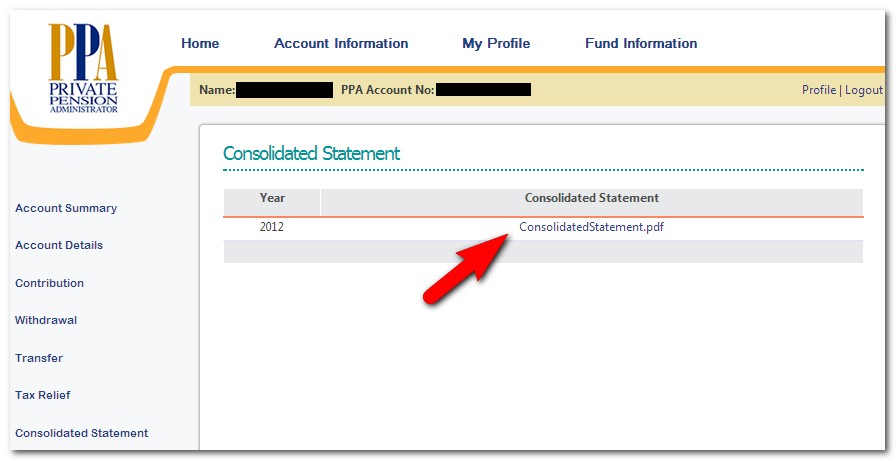
After log in, you will arrive at the following page. Supposedly, you can download the tax relief statement by clicking "Tax Relief".


However, you will be notified by this message.


Oppsss... What if I didn't keep the receipt or letter given by providers? No worry. Alternatively, you can download the "Consolidated Statement" as a proof and for income tax filling purpose. Hope this could clear your doubts. Happy income tax filing. Thanks.


Finance Malaysia would like to thank Alex Yeoh for his input in this article. Alex is a Licensed Financial Planner with VKA Wealth Planners, whom can advise and distribute multiple PRS products. You may contact him via email alexyeoh@vka.com.my

21 Nisan 2013 Pazar

Personal Income Tax for YA2012


Finance Malaysia hopes this article doesn't come late to give you some info on Personal Income Tax filling for year of assessment 2012. Maybe due to the general election, which had diverts our attention lately. Lol. Anyway, do remember to file your income tax before 30th April oh!!!

Well, here is the list of Personal Tax Relief for YA2012. And, I would like to highlight to you, in RED color words, some changes/differences from previous year.

Personal Tax Relief for YA2012
  • Item No.11:
    This would replace Item 10 from YA2012-YA2017 with higher amount of RM6,000
  • Item No.23:
    Private Retirement Scheme (PRS) is the NEW item which can help you reduce tax further with additional RM3,000 tax relief from YA2012-YA2021. As such, Item No.22 would be replaced until after YA2021.
All other items remained the same. Do reduce your tax payable by maximizing the tax relief amount. Remember to keep a record and file it properly. Happy tax filling. Thanks.

Blue color: Tax relief that we can adjust easily in our daily life
Green color: Tax relief for property not rented out with S&P signed between 10/03/09-31/12/10
Light red color: Tax relief related to child
Yellow color: Tax relief related to life insurance premium

19 Aralık 2012 Çarşamba

What are the TAX benefits from Private Retirement Scheme (PRS)?

According to Securities Commission of Malaysia, tax incentives are provided to both employers and individuals for the first 10 years from assessment year 2012; in addition to the tax deduction permitted for EPF contributions:
Amount of Tax Savings by individuals for PRS contributions
For Individual:
Tax relief of up to RM3,000 per year will be given for contributions made within that year. This is on top of existing tax relief already enjoyed by taxpayers. How much can you save from tax? Let's look at the table above which illustrates the amount of tax saving an individual get after personal tax relief and RM6,000 EPF + Life Insurance tax relief. Assuming maximum RM3,000 PRS relief, the amount of tax saving depends on your level of income. For high tax bracket individual, you can save up to RM780 annually!!!


For Employer:
Tax deduction on contributions to PRS made on behalf of their employees above the statutory rate of up to 19% of employees' remuneration was granted. Example, if an employer already making 12% EPF contributions to his employees, the employer may choose to reward their employees by contributing into employees PRS account for up to another 7%.


Vesting Schedule to Retain Employees?
Yes, employer can use PRS as a tool to retain employees by adding a "vesting schedule" clause. Currently, there are a few available vesting methods: by length of service, job rank, or by age. Unlike EPF, if an employee leaves before vesting, the employer can access to the un-vested portion of contribution already made. Likewise, for EPF, employee take the full amount when they left. With PRS vesting schedule, employee may think twice before switching jobs.

In conclusion, there are tax incentives for every tax payer, employee or employer. Ultimately, enough retirement funds was the key objective of PRS. On top of that, a tax exemption is also provided on income received by the funds under the PRS.


This is a guest post by Alex Yeoh in the series of Private Retirement Scheme. For more PRS info, you may contact Alex Yeoh (alexyeoh@vka.com.my), a licensed financial planner, whom can distributes products from multiple PRS providers. Thank you.

18 Aralık 2012 Salı

How Private Retirement Scheme (PRS) works actually?

Many people are still in the dark on how actually Private Retirement Scheme (PRS) works. In order to clear everyone's mind, we hope this post was timely for those who may want to entitle for extra tax relief of up to RM 3,000 given by PRS before 31st December 2012. To further explain the whole scheme, Finance Malaysia Blog was glad that Alex Yeoh, a licensed financial planner is able to share with us on this matter.


By Alex Yeoh,

First we must know that PRS is a voluntary scheme for the purpose of retirement saving. For ease of understanding, let us look at the picture above which explain the process into two parts. Initially, contributions were made by us into the PRS fund that we select. It was as flexible as  normal unit trust investments (shown in upper part). Contribute anytime any amount as you like, without any specific intervals. As simple as that.

When can I withdraw the money?
Each time, your contributions were split and maintained in sub-accounts A and B similar to EPF way (shown in lower part). 70% of contributions will go to Account A, which can be withdrawn upon reaching retirement age, which is currently at 55.

Meanwhile, the balance 30% into Account B, which can be withdrawn after one year, subject to 8% tax penalty. Take note that you can withdrawn from Account B for whatever reason. Although lump sum withdrawal are permitted, contributors are encouraged to retain their savings for continuous investment under the respective schemes.

Why 8% tax penalty?
The said 8% tax penalty was to discourage contributors to withdrawn their money prior to retirement age. We must understand that PRS is meant for retirement savings. Moreover, the 8% tax penalty was deducted from withdrawal amount to pay back Inland Revenue Board (IRB). Why? Because IRB is the one who gave you tax relief on contributions made initially. Otherwise, loop-hole was existed with everyone just want to take advantage of the tax relief and  withdrawn their money after that. Agree?

For more PRS info, you may contact Alex Yeoh (email: alexyeoh@vka.com.my), a licensed financial planner, whom can distributes products from multiple PRS providers. Thank you.

29 Eylül 2012 Cumartesi

Budget 2013: Election or Rakyat centric?

General election is around the corner. External environment was not so promising, following the no ending of European debt crisis, world economic slowdown, and recent tension between China and Japan. I believe all of these would be some key factors being taking into consideration to formulate the Malaysia Budget 2013.


Goodies? Bonus? Cash handout?
Themed as "Prospering The Nation, Enhancing Well-Being of the Rakyat: A Promise Fulfilled". Our prime minister, who is also Finance Minister, tabled the 2013 Budget at Dewan Rakyat yesterday. Over here, Finance Malaysia blog would only touches on some key points:
  • Economic growth projected to expand between 4.5% - 5.5%
  • Federal Government's revenue in 2013 is estimated to increase to RM208.6 billion
  • Continuation of BR1M of RM500 to households earning not more than RM3,000 a month and also extended the aid to cover a payment of RM250 for single unmarried individuals aged 21 and above, earnings not more than RM2,000 a month
  • RM 16 million a year group insurance scheme for registered hawkers and small businesses for coverage of up to RM5,000
    • FM: Once again goodies were dished out to created a feel-good factor for govt and we doubted whether Msia could achieves the 4% budget deficit target in 2013. Anyway, govt could still succeed by increasing the revenue by using these goodies. How? Very simple, that's to entice the non-registered self-employed and businesses to registered so that they are accountable for their earnings.


Spurring retail bond/sukuk market:
  • DanaInfra Nasional Bhd to issue retail bonds worth RM300million by end-2012 to finance MRT development projects
  • Additional expenses incurred in issuance of retail bonds and retail sukuk to be given double deduction for a period of 4 years from YA2012 to YA2015
  • Individuals investors given stamp duty exemption on instruments relating to transactions of retail bonds and retail sukuk
    • FM: It's very clear and straight forward that the govt want to see the soon-to-be launched retail bond/sukuk market to prosper, thus, attracting more foreign funds to the country to make it more vibrant and liquid.
Youth-centric offers:
  • A one-off rebate of RM200 for the purchase of one unit of 3G smartphone from authorized dealers for youths aged between 21 to 30 years old with monthly income of RM3,000 and below.
  • PTPTN loans: 20% discount for full repayment of loan; 10% discount for regular repayment.
  • RM250 1Malaysia book voucher for students studying at institutions of higher learning
    • FM: It seems too good to be true for PTPTN borrowers. But, it was attractive for probably 1% of them only. Why? We must remember that they borrow because they doesn't have money in the first place, not because they want to leverage. Do you get my meaning? Or, does govt scared if opposition coalition will void all outstanding loans if they took over?
Addressing the skyrocketing property prices:
  • RM500 million by PR1MA to build 80,000 houses in major locations nationwide with selling price ranging between RM100,000 and RM400,000 per unit. Among the locations are KL, Shah Alam, JB, Seremban and Kuantan.
  • MyFirst Home Scheme will be enhanced by increasing the income limit for individual loans from RM3,000 to RM5,000 per month or joint loans of husband and wife of up to RM10,000 per month.
  • Real Property Gains Tax (RPGT) for properties disposed within 2 years will be taxed at 15% (up from 10%) and 10% for between 3rd to 5th year (up from 5%), whereas other term remained unchanged.
    • FM: For us, we think that 15% RPGT is still too low if compared to pre-2007, where RPGT for first 2 years disposal was as high as 30% and 25%. Meanwhile, MyFirst Home Scheme was very tough to get it, as far as we concerned. Once again, good luck to those potential property buyers.
Changes to personal income tax:
  • Individual income tax rate to be reduced by 1% for each grouped annual income tax exceeding RM2,500 and RM50,000.
  • Tax relief on children's higher education scheme (SPNN) increased to RM6,000 per person (from RM4,000 previously).
    • FM: The 1% tax reduction seems more effective to help out those mid-income earners, although it's not much. However, we are disappointed once again for the unchanged REITs withholding tax structure which makes M-REITs less attractive compared to regional REITs.
Government servants is the BIG winner AGAIN!!!
  • Minimum pension to be increased to RM820 for those who had served the govt for at least 25 years. More than 50,000 pensioners benefited.
  • 1.5 months bonus for civil servants.
    • FM: Well... Nothing much we can say about it. This is a govt budget. What's wrong if govt servants being the beneficiary? But, should it be again and again? Hmmm...

"Stocks-to-watch" for the coming Monday:
  • Genting, GENM, JTI, BAT on the surprise unchanged sin taxes
  • Construction companies on the River of Life projects, EPP projects and schools upgrade
  • Consumer related players on the expected extra spending by govt servants with bonuses
  • Low cost housing developers (etc. Hua Yang) for possible contracts by PR1MA
  • Financial institutions with investment banking arm for the launching of retail bond/sukuk market

12 Mart 2012 Pazartesi

Why All of Us Must Care about 1Care Malaysia?

Heard about 1Care Malaysia healthcare plan? If no, then you must read this article thoroughly word by word. Because the the proposed healthcare system will drastically change the way we seek for treatment in the future. The main issue was "Is it viable to implement 1Care?".


Well, the intention is good for our community. The plan had a very beautiful definition as below:


But...

Concern is always there whenever Government want to implement something and that thing is managed solely by Government. Experience? Got (bad experience). Money? Got, but already drained somewhere (normally). You can't prevent Malaysians from worrying, especially when 1Care touches each and everyone of us for life.

What are the concerns?
  1. Each person in different sector have different risk level. How to determine the amount of contributions of each contributor?

  2. Subsequently, how to determine the benefits package each individual entitled to? If the benefits was based on the amount of contribution, then, our existing insurance system already functioning very well now.

  3. Then, you can say that it was community-rated, not risk-rated. That's mean rich are subsidizing the poor, economically active to passive system. But, doesn't rich already pay taxes to government to subsidize them currently?

  4. Level of services of hospitals and choices of hospitals. Can we seek treatment at any hospital, be it general or private hospitals? If not, it will again limit our choice.

  5. Choice? Emm. The proposed 1Care is being made compulsory to all employees and employers to contribute (except government servants). Wait!!! Does this mean that private sector is subsidizing public sector?

  6. A government agency was being set up to manage the pool of money collected from all of us. OMG!!! We are talking billions of ringgit per year. It's a huge huge huge amount which could bought over CIMB bank!!!

Once 1Care was implemented, the following sector will suffer:

  1. Private sector. If the said 10% mandatory contribution by each employee is true, most salary based person will switch to personal loan, I think.

  2. Retailers will suffer badly from less disposable income after the mandatory deduction of salary. No more 25% drop in car sales anymore. It's probably 90%.

  3. Property market will slump. Don't forget that our loan applications now is based on net salary, which means deducting your 11% EPF + 10% 1Care + Socso + Tax. How much left?

  4. Private healthcare system. Private hospitals have to lobby smartly to get involved in 1Care system to remain in business. Monopoly game means you have to "pay" more? Good Luck.

  5. Private insurance companies and its agents. A big chunk of their medical policies will be terminated and a big chunk of premiums will flow to the new set up government agency. Thousands of agents will struggle to survive.


Then, why Government proposing 1Care Malaysia? Emm. I got many input from friends and professionals and below could be the 3 reasons behind 1Care:
  1. Diversifying the problems of public healthcare system to private healthcare, so that private healthcare was forced to collaborate.

  2. Reducing Government's burden, thus reducing budget deficit, by imposing mandatory contribution from everyone. For us, it's just like another form of income tax.

  3. Hijacking the lucrative insurance business which was dominated by foreign companies (etc. Great Eastern, Allianz, AIA, Prudential, ING...) especially on medical policies. With 1Care, it could effectively grab the market share from them, entrusting government agency as the undisputed largest insurance company in Malaysia.

Finance Malaysia blog is just voicing out the concerns of general public for betterment of Malaysia going forward. Readers were welcome to give comment or feedback. Thanks.

3 Nisan 2011 Pazar

Personal Income Tax: Child Relief

When we are having children, it's a gift from God. And, Malaysia is a blessed place to live, a place where no earthquake and volcano. Although we once hit by tsunami, but it brings minimal effect to us. Thank God.


In line with the effort to increase Malaysian workforce, in achieving self-sustainable economy with strong domestic consumption, Government has laid out several tax relief especially meant for child. Dubbed as one of the "major investment" of a family, raising up a child could easily cost a family few hundred thousands (if not millions). Let's take a look at some of the tax advantages of having a child.

Child Tax Relief
Married couple can claim child relief of maintaining any child. The children can be their own child, step child, or legally adopted child. Then, there are subdivided into 4 different categories.

Source: IRB, Finance Malaysia Blog

Generally, parents can claim tax relief of RM1,000 per unmarried child per year, until he or she turns 18. An unmarried child who is over 18 and continuing full-time education at a secondary school, he or she entitles the parent to a RM1,000 tax relief.


Meanwhile, parent may claim a tax relief of RM4,000 once the child is 18 and above, and pursuing full-time tertiary education (diplomas and above qualifications) locally or overseas. The said tertiary education must be a program and in Higher Education Institute that is accredited by related Government authorities.


For those unfortunate Disabled child, the tax relief is RM5,000 per year as long as he/she is unmarried. Other than that, an additional relief of RM4,000 will be granted if the disabled child pursues a full-time tertiary education just as an ordinary child mentioned earlier.

Frequently Asked Questions
  1. Is there a limit to the number of child entitled for child relief?
    • There is NO limit to the number of child, but please take note that relief will only be given to unmarried child.
  2. Can husband and wife claim for the same child relief?
    • NO. Instead, the child relief should be claimed by either spouse who has the highest taxable income in order to minimize the tax payable. It should never be divided between husband or wife.
Source: IRB

29 Nisan 2010 Perşembe

Tax Relief from Life Insurance YOU must know

Want to get more tax saving? Please read on…

Although this article is somewhat considered late for individual tax-payers this year, this could be useful next year anyway. When you buy insurance, besides getting the comprehensive protection and a worthwhile investment that will keep you financially stable should the unexpected happen, one more feature are very important for every tax payers.


Under Malaysian Income Tax Act 1967, you will also enjoy tax relief benefits provided. These tax incentives are given by Malaysia government to encourage us to own a protection plan, thus, inducing a better life planning among Malaysians.

Oppsss... actually this can and that one is cannot?


So, what are the tax relief?
  • Premiums on life insurance and/or deferred annuities.
  • Premiums on education or medical benefits.
How much tax relief?
- Up to Rm6,000 for life insurance premiums and EPF contributions.
- Up to Rm3,000 for medical and education policies premiums.

You may qualify for tax relief under Education policies if:
  • Beneficiary is the child.
  • The life assured is the parent and the child is the nominee.
  • Maturity amount must be payable when your child is between the ages of 14 to 25 years.
Or,
  • The life assured is the child.
  • Parent is the proposer.
  • Payer benefit is attached for the full term.
  • Maturity amount must be payable when your child is between the ages of 14 to 25 years.
You may qualify for tax relief under Medical policies if:
  • Expenses are related to medical treatment resulting from a disease, accident or disability.
  • The policy must be for coverage of 12 months or more.
  • Both standalone policies and riders qualify, but if it is a rider, only the rider premium qualifies for deduction.


Common Mis-understanding:
How do I know how much relief  can I deduct every year?
Every year, your insurer will send you a statement for tax relief purpose and you just need to fill in the entitlement amount according to different category of relief. You may request from your insurance company or agent, if you receive it by mail.

My premium is Rm2,400 . Why the statement only shows Rm1,800?
Tax deductible is based on the actual premiums paid for that particular year. In this case, you only paid Rm1,800 for that year of assessment.

My premium is Rm2,400. Why I can’t relief full amount?
This may due to administration fees, or certain riders which does not qualify for any relief.

If I buy insurance for my parents, can I get the relief?
NO. Your parents can get deductions if they bought insurance for their own. However, you may claim for your parents’ medical expenses of up to Rm5,000.

Not enough?
From 2010 onwards, premium on annuity scheme or additional premium paid on existing annuity scheme is qualify for another Rm1,000 relief. Amount exceeding Rm1,000 can be claimed together with life insurance premium category.


Since the above criteria may change from time to time by government, please seek advice from your own tax consultant if needed. Thanks.