government etiketine sahip kayıtlar gösteriliyor. Tüm kayıtları göster

25 Temmuz 2015 Cumartesi

The valuable lesson taught by GREECE... (For Malaysia...)

Ever since the beginning of the whole episode of the GREECE problem which caught the attention of the world, do you really know what's the root of the problem? Is it the people? Or, the lack of natural resources? Or, politicians?


Let's have a read here...


Yup. Many people are saying that the people there are lazy (working less hours) if compare to other European, yet they are enjoying the same quality of living or benefits like counterparts.

Then, many analysts said that the lack of natural resources resulting the GDP growth of the country being dampened. Currently, Greece's GDP is mostly based on their shipping business, tourism and production of fine wine and olive oil. But, this is not enough to generate sufficient tax revenue to cover the social benefits provided by government.


The root of the problem is this...


In order to continue enjoying the great lifestyle, Greece are "financing" it with borrowings from IMF and ECB. Why do so if Greece knows that they can't afford it? Who make the decision to do so?


Obviously, politicians or the empowered government was the one to blamed. Previous politician candidates are lauding the feel good election campaign by dishing out all the goodies and perks to win votes. Yes, they succeed eventually with the belief from voters. Yet, they created the bomb which exploded few years back, which until now still can't defuse it.


"It's always easy to give hopes to people, but it's hard to convince people to accept the reality."


Lesson Learn: We need politicians whom can govern our country properly, not those who can only simply give hopes and then went into troubles. Voters should not vote based on how much goodies they can get during election campaign. We should think rationally what's good for the country in the long run, not only during or after one election. In the end, who will suffers the most as experienced by Greece currently? It's the people...

Do you want Malaysia to be another Greece?

*** Disclaimer: NO political comments or feedback here. It's just a pure blog post for everyone to ponder. ***

8 Nisan 2015 Çarşamba

What is PTPTN Income Contingent Loan ?


Most of the Malaysian who study local universities will borrow from the National Higher Education Fund Corporation (PTPTN). Meaning all of those undergraduates are actually indebted when they further their tertiary studies. Well, this is consider a good debt instead if you finished your study and get a good job to repay back the loan later.


However, statistic shows that many of those graduates defaulted their PTPTN loan after graduating from universities. Few years back, government even reduces the loan interest from 3% to 1% p.a. but yet still no improvement. How about 20% discount if you settled off your loan in one lump sum?


Still not enough...

Another good news to PTPTN loan borrowers, government is introducing the new repayment term called "Income Contingent Loan", which allows borrowers to delay their repayments until they reach a certain level of income. Currently, loan borrowers have to start their repayments 6 months after finishing their study.

How much is the income threshold ?
This is the most crucial question after the announcement. So far, we still don't have the answer yet. And, this will definitely benefiting those low income graduates.

Anyway, there are more queries such as below:
  • Would it be RM3,000 monthly income threshold ?
  • Would it affecting the existing loan borrowers ?
  • How about the schedule of repayments?

24 Mart 2015 Salı

[Credit Card] What are the Changes after GST implementation?

For credit card holders, there is confusion on how GST is being charged. Over here, we are talking about the service tax and annual fee. Currently, there is a RM50 service tax on principal card holder and RM25 service tax on supplementary card holder. After 1 April 2015, this service tax will be abolished due to the implementation of GST.


How about the annual fee?

However, 6% GST will be imposed on the credit card annual fee which ranges from RM50 up to RM500, depending on the type of card. For example, for a RM50 annual fee, there will be an extra RM3 GST charge on it, resulting to a total of RM53 when renew.

Anyway, most of the banks will waive the annual fee if card holder meet certain minimum requirements, or card holder can utilized their loyalty points or rebates to offset the 6% GST.

How about late payment or finance charges?
Late payment charge means card holder fails to pay at least the minimum monthly charges when due. Meanwhile, finance charge means charges imposed on outstanding balance which has not been settled. The good news is BOTH of these charges will NOT be burden by the 6% GST charge.


Do I have to pay GST each time I swipe my card?

Be it debit or credit card, there is NO additional GST charge each time you swipe. For example, if the bill is RM100, the amount swipe is still RM100 instead of RM106 as being speculated.


But, I saw 10% service tax.
What's that? Will it be abolished also?
We need to be clear over here. The normal 10% service tax stated in many bills such as restaurant and hotels booking is actually a form of tips for their employees who serve us well. In order not to make everyone confuse, government already started to instruct all business operators to change the word "service tax" to "service charge". Since this is not a form of tax, customers are not obliged to pay service charge. Just bear in mind, that's actually a form of tips. If you think that the service is not good, why paying them?

21 Kasım 2014 Cuma

RON95 Petrol: What does it mean by NO MORE SUBSIDIES ?

Today, the hottest topic in town was "No more subsidies on RON95 and Diesel starting Dec 1". While the starting date is just a mere 10 days from now, it catches every Malaysian by surprise. No wonder netizens share this news all over in social medias discussing about this matter and alert other petrol users.


How to determine the prices?

Based on news report, the Domestic Trade, Cooperatives and Consumerism minister, said the retail prices of RON95 and Diesel will be fixed according to managed float, similar to the mechanism dictating the RON97 petrol price. He added that there will be an announcement at the end of each month to set the following's month fuel prices, to be determined based on a monthly's average price.


What's the rationale behind?
Many observers see this as the beginning step for Government to start implementing the much debated "income-based fuel subsidies" which is based on salary of an individual. Anyway, how was it going to be implemented was still unclear at this juncture.


How about RON97?

  • First, we saw RON95 price increase by 20c to RM2.30 on Oct 2.
  • Second, we saw RON97 price decrease by 20c to RM2.55 on Nov 19. 
  • Then, starting Dec 1, RON95 and diesel price will be no more subsidized.

Wait... Something was wrong over here... Why the more premium RON97 will remained subsidized after Dec 1? Shouldn't it be another way round instead?


What does it mean?

If world oil prices shot up in the next few months, we may experiencing a more premium RON95 (in terms of pricing), if RON97 prices remain unchanged. Of course, we as a consumer will make a comparison and pump accordingly. In fact, many people started to pump RON97 due to the mere 25c price difference currently. Happy pumping !!!


10 Ekim 2014 Cuma

Budget 2015: The People's Economy... What's in it for YOU ?

The much awaited Budget 2015 was presented by our Prime Minister at Cabinet today. Looking on are hopeful Malaysians with their never ended wish lists, which already submitted via various channels. Does your wishes being addressed in the budget?


The People's Economy...


This is the title for Budget 2015, which referring to an economy that based on the daily lives of the rakyat. Very obvious, this is to address the concerns of the rakyat towards the implementation of GST soon.


What's in it?
Here, we only highlighting a few key points which related closely with most Malaysians:


  1. Several infrastructure projects will be implemented:
    • Sungai Besi - Ulu Klang Expressway (SUKE)
    • West Coast Expressway from Taiping to Banting
    • Damansara - Shah Alam Highway (DASH)
    • Eastern Klang Valley Expressway (EKVE)
    • East Coast railway line along Gemas-Mentakab, Jerantut-Sungai Yu and Gua Musang-Tumpat
    • 2nd MRT Line from Selayang to Putrajaya
    • LRT 3 Project, linking Bandar Utama to Shah Alam and Klang

  2. On GST, an additional lists of items that will not be subjected to GST as follows:


  3. In addition, GST free for electricity consumption be increased from the first 200 units to 300 units.

  4. No GST for the purchase of RON95 petrol, diesel and LPG
  5. YA2015 for individuals and households:
    • Individual income tax rates will be reduced by 1% - 3%
    • Tax payers with family and income of RM4,000 monthly will not have tax liability
    • The current 26% individual income tax will be reduced to 24%, 24.5% and 25%

  6. Corporate Tax:
    • YA2015: Cooperative income tax rate will reduced by 1% - 2%. Secretarial fee and tax filing fee are allowed as deduction
    • YA2016: Corporate income tax rate will be reduced to 24%
    • YA2016: Income tax for SMEs will also be reduced to 19%

  7. PTPTN Loan:
    • 10% rebate given to borrowers who continuously make repayments for 12 months until 31 December 2015.
    • 20% discount to borrowers who make lump sum repayments from now until 31st March 2015.

  8. Youth Housing Scheme... What's the terms and conditions ?
    • Smart partnership between Government, Bank Simpanan Nasional, EPF and Cagamas
    • For married youth aged between 25 - 40 years
    • Household income not exceeding RM10,000
    • Maximum funding for 1st home is RM500,000
    • Maximum loan period is 35 years
    • Government will provide monthly financial assistance of RM200 for first 2 years
    • 50% stamp duty exemption on instrument of transfer agreements and loan agreements
    • 10% loan guarantee to enable borrowers to obtain full financing including cost of insurance
    • Only for 20,000 units offered on a 'first come first serve basis'

  9. Goodies for students:
    • Jan 2015, RM100 each be given to all primary and secondary school students
    • 1Malaysia Book Voucher of RM250 per student

  10. Expenses incurred for treatment of serious diseases are given tax relief up to RM6,000 per year (from RM5,000 currently). This is available to tax payer, the spouse and children.

  11. Increase tax relief for each disabled child from RM5,000 to RM6,000

  12. Home ownership:
    • PR1MA with 80,000 units to be build
    • Ceiling of household income is raised from RM8,000 to RM10,000
    • Rent-To-Own scheme will be introduced specifically for individuals who are unable to obtain bank financing
    • Extending the 50% stamp duty exemption until 31st December 2016
    • Increase the purchase limit from RM400,000 to RM500,000
    • Skim Rumah Pertamaku with ceiling price raised to RM500,000, and age of borrowers to qualify for the scheme increased to 40 years old
  13. BR1M will be continue:
    • RM950 for households with monthly income of RM3,000 and below. It will be disbursed in 3 installments in Jan (RM300), May (RM300) and Sept 2015 (RM350)
    • RM750 for households with monthly income between RM3,000 and RM4,000. It will be disbursed in 3 installments in Jan (RM200), May (RM200) and Sept 2015 (RM350)
    • RM350 for single individuals aged 21 and above with monthly income not exceeding RM2,000.

  14. Half-month bonus for civil servants with minimum payment of RM500 to be paid in Jan 2015. Meanwhile, Government pensioners will also receive special financial assistance of RM250.


20 Mayıs 2014 Salı

Should MAS Went into Bankruptcy? (May 2014)

This is really a multi-billion ringgit question. Since MH370 flew to the great Indian ocean, the share price of MAS also went that deep down under. It has fallen to as low as RM0.15 on 19th May 2014, the lowest level in at least 10 years. It was the most actively traded penny stocks in Bursa Malaysia for past few days.


What should be the best solution for MAS ?

The plunge that day was due to reports saying that Prime Minister is exploring the possibility of letting MAS to file for bankruptcy. Would it be a wise move? Let's us look at a few more alternative ways to rescue MAS financially.


  1. MAS to raise capital via private debts, be it issuing new shares or bonds.
    Easy to issue, but who is going to subscribe for it? In order to make it attractive enough, the bond paper must be backed by government and offering above than average yield. Higher yield means higher financing cost for MAS.

  2. MAS to sold off its assets.
    After various rounds of turnaround plans, what assets still left other than those airplanes? Some more, were those assets have such significant value attached to it... still?

  3. Borrow money from financial institutions.
    Here, I really have to pity those banks whom already borrowed money to MAS. If not because of this "government-linked company" status, I believe they won't borrow at all without a favorable interest charged.

  4. MAS sold down its equity stakes, or being privatized.
    As a national carrier, partnering with another foreign carrier? You must be joking... Unless, it was being privatized and government ceased as shareholder. But, once government letting go his hands, would anyone interested to take over MAS?

  5. Government continue pumping in money.
    Well, this is in fact the most common way seen in Malaysia. Being a GLC, MAS has this privilege since it was being incorporated. But, rakyat already started to voice their concern on how government spend money, especially on those consistent loss-making companies. It was like continue throwing money into Indian ocean once again.


Moreover, the business of MAS already dropped 60% since the missing of MH370. Coupled with a total net debt of around RM7 billion, how long can MAS survive? If government wants to preserved the national icon status, they must ready to pump in another few billion ringgit without money-back guaranteed.

In our opinion, filing for bankruptcy is indeed a wiser move for all parties (other than banks), sorry to say that. This is the only fastest way to clear all the current bad debts and start all over again for MAS. If Japanese airline JAL can done it successfully few years back and making profit now, why not MAS ?

27 Ekim 2013 Pazar

Budget 2014: Property Sector Hit Hard by RPGT and DIBS ruling

As widely expected, property sector would be one of the hardest hit sector in view of the proposed cooling measures to be imposed. Out of the 3 tightening rules forecast by Finance Malaysia, 2 already Bingo! (Read our previous articles regarding property sector "3 Tighter Rules for Property Sector?" and "3 Critical Factors to watch out by Year End")


These cooling measures announced highlighting that government will not hesitate to curb property speculations and to ensure a affordable property prices. Of course, property developers will be the one screaming painfully.

The 3 Key Measures:


  1. Higher Real Property Gains Tax (RPGT)
    This was the 3rd consecutive year government raised RPGT. Even said so, it was just reinstated back to its original rates since 2007. The different this time compared to previous rounds was different set of rates to be imposed on different categories of buyers as shown below:


  2. Banning DIBS
    As predicted by us previously, DIBS was deemed to be one of the key motivating factor for speculators, thus pushing up property prices to current level. By banning DIBS, it will effectively diminished the speculative interest as the cost of investment increase with interest payment during construction period. It's good to genuine and first-time house buyers.

  3. Higher minimum Purchased Price for Foreigners
    To minimized influx of hot money shoring up local property prices, government raised the minimum purchased price to above RM1mil from RM500k per unit. However, this doesn't impact the market much because most properties purchased by foreigners are above RM1mil. Nevertheless, foreigners' favorite investment hotspot, such as Iskandar or KLCC or Mont Kiara area would be affected.

Would this be the end of property up-cycle?

25 Ekim 2013 Cuma

Budget 2014: Good to have GST ?

Definitely, one of the hottest debate in Budget 2014 would be the implementation of 6% Goods and Services Tax (GST) starting April 2015. Although it was opposed strongly by opposition parties, government pushed ahead with its implementation emphasizing GST as a "fair and comprehensive" tax as the current tax system has many weaknesses.


Why GST is a MUST ?
Without you realizing, our current tax system has many loopholes whereby many people do not fulfill their responsibilities as a taxpayer. They tends to under-stated their real income, paying less tax than they should, or even worse... none. However, under the GST system, everyone will be taxed every time you spend.

And, if you're paying tax now, you should be happier. Why? Simply because government have a wider tax revenue now with GST because everyone is paying tax. Wouldn't it better?


Why April 2015 ?
Instead of Jan 2015 (expected date), government now has more time to explain and educate the public on GST. In other words, government is playing it safe, "buying time" to minimize the misunderstanding among Malaysians.

Is it okay ?
Implementation is very vital. It's best to implement GST and lowering down the personal income tax rate simultaneously. And, this time government did consider this well. As long as it was implemented properly, this should bode well for our nation to broaden the tax revenue, thus reducing the budget deficit and maintaining the credit rating of our country's obligations.

Why MyEG ?
Strange question over here? Yes. As we knew, MyEG already successfully completed its trial version for GST computation in business premises. Do you know why MyEG shoot up to all-time high to closed at RM2.25 today?


19 Ağustos 2013 Pazartesi

Should or Would Government Privatizing MAS? (Aug 2013)

Both of our ex & current Prime Minister already voiced their views regarding this matter. Yesterday, our ex-PM said Government should SELL MAS if it can be run more effectively by private sector. Meanwhile, when asked, our current PM said there was no plan to privatize MAS now because it was on track to its turn around plan under the helm of new management. So?


In fact, this was like a million ringgit question for many speculative investors. Maybe, they or YOU were hoping for the deal to materialize if you bought the shares just recently. Anyway, it won't be as easy as you might think.

  1. MAS is a national carrier. It carries the national flag wherever it goes. (Some more, national day is approaching now)
  2. How much to privatized? Especially for a still loss-making company... Definitely, Government won't get much if MAS being privatized now.

However, everything is possible given the facts below:

  1. National company is just a company anyway. We have just witnessed the privatization of KTM, POS and PROTON few years back.
  2. Government's coffer is more important. You can't keeps on letting the pumping money to save a company. Why not let go the 'vampire' of money?


The score now is 2-2. Anything to add?
* Hint: RHB research puts in a target price of RM0.43 for MAS in its report dated 25th July 2013. It this was the offered price, would you satisfy?


Conclusion:
It depends on whom being asked this question. If posted to share investors, the answer would be YES because you most probably can profit from it (if higher premium was offered). However, the answer might be the opposite if posted to Government.

19 Temmuz 2013 Cuma

[Property] 3 Critical Factors to Watch Out by Year End (July 2013)

Ever since the property boom started in 2009, right after the global financial crisis, investors were laughing to the bank. But, can these sustain until next year? Many analysts doubt so. Why?


The most crucial determining factors might uncover itself in the next few months, approaching year end. In short, we have summed out to the below 3 critical factors:
  1. Banning of DIBS
    This is not a secret anymore. Speculation rife up recently, saying that BNM may ban the Developer Interest Bearing Scheme (DIBS) by year end. BNM is studying the implications of DIBS which benefiting speculators more than serious buyers. Note: Singapore already banned such scheme few years back.

  2. Interest Rate hike
    BNM also may revised the Overnight Policy Rate (OPR), which determine the cost of financing in the country including Base Lending Rate (BLR) for mortgage loan. A 25 basis points hike was expected. This will affect all type of loans, except fixed interest loans. Let's get prepare for higher monthly loan installment amount.

  3. Higher RPGT
    Coming this 2014 budget to be tabled on 25th Oct, watch out for higher Real Property Gain Tax (RPGT). Currently, it was 15% for first two years and 10% for disposal from 3rd year to 5th year. Note: RPGT was much higher before 2008.


In our view, once DIBS was banned, developer no need to bear the interest, financier no need to bear the risk, new launching properties should be selling at lower price. Then, this is bad news for existing property, especially bought under DIBS before?


Example, phase one selling at RM500k under DIBS, phase two selling at RM500k without DIBS. No effect?


Think again... More supply now releasing for secondary market, assuming phase two also selling at same price, which is very good already. Right?


24 Haziran 2013 Pazartesi

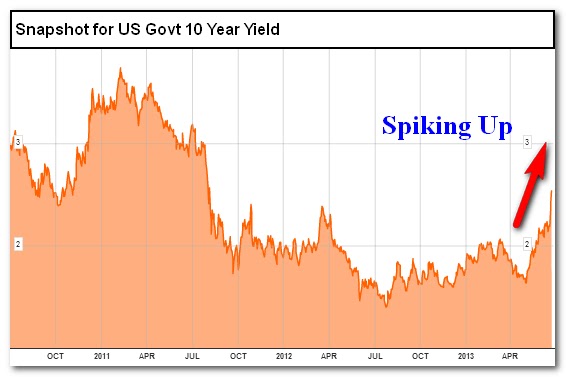
Understanding US Treasury & Yields


Just when the whole world coming for a rout, only US treasury yields shoot up to multi-months high. Investors might wondering why this happen. Some of our readers are posting these kind of question to us. We think this article might helps.


US Treasury = US Government Bond

Actually, we are referring to US Government 10 Years Bond. Generally, a government bond is issued by a national government (in this case US) and is denominated in the country's own currency (USD). Bonds issued by national government in foreign currencies are normally referred to as sovereign bonds. The yield required by investors to loan funds to governments reflects inflation expectations and the likelihood that the debt will be repaid.

Also, government bonds were usually referred to as risk-free bonds, because governments could easily devalue their currencies or raise taxes to redeem the bond at maturity. 


The Story of US Treasury Yields...
Just like Base-Lending-Rate (BLR) for Malaysia, everything from mortgages to corporate loans in US depends on US treasury yields. Higher yields mean higher borrowing costs. To stimulate the US economy, Federal Reserve had came out with various Quantitative Easing (QE) actions to bring down the said yields, allowing borrowers access to cheap funding. How to bring down yields? Federal Reserve will buy back US treasuries, thus, flooding the market with money. The side effect was a weakening USD.


However, all things will change 360 degree, if Federal Reserve start to slow down or totally stop their so called QE3. This is what happening now, creating uncertainties to global markets.

15 Ocak 2013 Salı

What's Wrong for an Economist to Predict the Upcoming Election?

I am writing this post during midnight after I came across a report saying that Bank Islam chief economist suspended after predicting that opposition will win the upcoming election. As usual, Finance Malaysia would NOT include political elements in its blog post. And, we would like to stress here again, that we are discussing this topic WITHOUT any political elements. Then, what are we talking here?


FREEDOM of VOICE & OPINION
I knew that I could not sleep if I didn't speak up for En. Azrul Anwar. We are not here to defend anyone, neither to offend any parties. But, we should open up our mind, and accept other opinions with open heart. In this matter, the said bank is losing its credibility and reputation by suspending one of its key staff --- just because of his prediction. Why can't he speak freely? Will the bank lose its banking license because of this?

Does he answer the question wrongly? NO... It's a prediction only, there is no right or wrong here.


Everyone knew that political changes is the key risk for Malaysian economy this year. Can an economist avoid this topic? Or, should they answer the same question with the same biased answer? Otherwise, who will listen to their opinions? Then, why a company hires an economist to represent them in the first place?

Funny... That's why Finance Malaysia blog is another channel for investors and readers to get 3rd party opinions and views. Blogging industry will prosper even faster, because the demand is there. Readers DO NOT want to read biased newspaper or news portal anymore. Thanks for your support. Finance Malaysia supports Azrul Anwar.

27 Kasım 2012 Salı

ETP update: 10 Key Achievements (Nov 2012)


Below is the 10 key achievements highlighted by CEO of Pemandu, that demonstrates the positive inroads of the ETP:
  1. Projects will be implemented within the 12 focused National Key Economic Areas (NKEA) and also implement 51 Strategic Reform Initiatives (SRI) to ensure competitiveness will flourish.
  2. Whilst Malaysia's GNI per capita was only US$6,700 in 2009, it grew dramatically by 45% in 2011. (Target is US$15,000 by 2020)

  3. GDP grew by 5.3% year-to-date. This is significant, considering Singapore's growth of only 1.3% while neighboring countries recorded the following GDP growth:
    • Thailand 3.0%
    • South Korea 1.6%
    • Taiwan 1.0%
    • Hong Kong 1.3%
  4. Economy continues to grow to reach new GDP and GNI records in 2011, with Government achieved its highest revenue in history with RM185 billion in 2011, allowing the Government to implement many programmes, including those under GTP such as BRIM1 and BRIM2.
  5. Private investment continues to achieve robust growth. As of Sept 2012, private investment grew by 25.5% yoy, reaching a new record of RM112.2 billion.


  6. Domestic private consumption continues healthy growth of 8.2% year to date, an evidence of growing disposable income by Malaysians.
  7. FTSE Bursa Malaysia KLCI market capitalization scaled new historic high on 1st Nov of 1,675.69 points, with market capital Rm1.46 trillion.


  8. Consistent delivery of fiscal deficit reduction from 6.6% of GDP in 2009, 5.6% in 2010, 4.8% in 2011 and further reductions are planned in 2013 and beyond. Debt ceiling was capped at 55% of GDP.


  9. Recognition of Malaysia's tremendous progress by external parties such as World Bank (ranking in Doing Business), AT Kearney's FDI confidence index, IMD World Competitiveness Yearbook, WEF Global Competitiveness and CNN ranked KL as 4th best shopping cities.
  10. Achievements against the KPI were at 123% in 2011 and 94% this year


Source: etp.pemandu.gov.my (summarized by Finance Malaysia blog for ease of reading)

8 Kasım 2012 Perşembe

What is US "Fiscal Cliff" actually?

When everyone thought that US and the world will be better if Obama won his presidential re-election again, world equities markets today declines with US being the most serious market by dropping more than 2%. What's the reason? Answer: Fiscal Cliff ?


Hmmm... Then, what is fiscal cliff actually which many of us on the street do not even heard about this new term before. No worry, Finance Malaysia blog did his homework over here. Share this out if you like.

Understanding Fiscal Cliff...
The US fiscal cliff refers to the effect of a series of enacted legislation which, if unchanged, will result in tax increases, spending cuts, and a corresponding reduction in the budget deficit. With Obama retaining the presidency, it sends the signal that it's US government policies will pretty much stay the same as previous 4 years. Ben Bernanke will stay as Fed chairman, which also meaning that the open-ended liquidity and bond buying programs will continue, fueling risk taking appetite of equity and fixed income markets for the foreseeable future.

Budget deficits, projected through 2022. The "CBO Baseline" shows the effects of the fiscal cliff under current law. The "Alternative Scenario" represents what would happen if Congress extends the Bush tax cuts and repeals the Budget Control Act-mandated spending reductions beyond the end of 2012.
However, Obama has to resume his duties in a very likely divided congress, with Republicans controlling the House and Democrats controlling the Senate. With this political deadlock and the looming "Fiscal Cliff", that's the reason why US market sink this morning.

Good or Bad?
If you understand it, the so called "Fiscal Cliff" is not something bad, in which its purpose is to reduce budget deficit of US. What investors worried was the measures being taken will slow the already slow growth rate of US economy, subsequently the world economies including Asia. But, without the intention of reducing budget deficit of US, would you be more confident? Of course NOT, because US would never able to not walk out from the brushes. Right?

By now, you should be able to understand the term. Meanwhile, some analysts have argued that "fiscal slope" or "fiscal hill" would be more appropriate because while the cumulative economic effect over all would be substantial, it would not be felt immediately but rather gradually as the weeks and months went by. Hahaha...


29 Eylül 2012 Cumartesi

Budget 2013: Election or Rakyat centric?

General election is around the corner. External environment was not so promising, following the no ending of European debt crisis, world economic slowdown, and recent tension between China and Japan. I believe all of these would be some key factors being taking into consideration to formulate the Malaysia Budget 2013.


Goodies? Bonus? Cash handout?
Themed as "Prospering The Nation, Enhancing Well-Being of the Rakyat: A Promise Fulfilled". Our prime minister, who is also Finance Minister, tabled the 2013 Budget at Dewan Rakyat yesterday. Over here, Finance Malaysia blog would only touches on some key points:
  • Economic growth projected to expand between 4.5% - 5.5%
  • Federal Government's revenue in 2013 is estimated to increase to RM208.6 billion
  • Continuation of BR1M of RM500 to households earning not more than RM3,000 a month and also extended the aid to cover a payment of RM250 for single unmarried individuals aged 21 and above, earnings not more than RM2,000 a month
  • RM 16 million a year group insurance scheme for registered hawkers and small businesses for coverage of up to RM5,000
    • FM: Once again goodies were dished out to created a feel-good factor for govt and we doubted whether Msia could achieves the 4% budget deficit target in 2013. Anyway, govt could still succeed by increasing the revenue by using these goodies. How? Very simple, that's to entice the non-registered self-employed and businesses to registered so that they are accountable for their earnings.


Spurring retail bond/sukuk market:
  • DanaInfra Nasional Bhd to issue retail bonds worth RM300million by end-2012 to finance MRT development projects
  • Additional expenses incurred in issuance of retail bonds and retail sukuk to be given double deduction for a period of 4 years from YA2012 to YA2015
  • Individuals investors given stamp duty exemption on instruments relating to transactions of retail bonds and retail sukuk
    • FM: It's very clear and straight forward that the govt want to see the soon-to-be launched retail bond/sukuk market to prosper, thus, attracting more foreign funds to the country to make it more vibrant and liquid.
Youth-centric offers:
  • A one-off rebate of RM200 for the purchase of one unit of 3G smartphone from authorized dealers for youths aged between 21 to 30 years old with monthly income of RM3,000 and below.
  • PTPTN loans: 20% discount for full repayment of loan; 10% discount for regular repayment.
  • RM250 1Malaysia book voucher for students studying at institutions of higher learning
    • FM: It seems too good to be true for PTPTN borrowers. But, it was attractive for probably 1% of them only. Why? We must remember that they borrow because they doesn't have money in the first place, not because they want to leverage. Do you get my meaning? Or, does govt scared if opposition coalition will void all outstanding loans if they took over?
Addressing the skyrocketing property prices:
  • RM500 million by PR1MA to build 80,000 houses in major locations nationwide with selling price ranging between RM100,000 and RM400,000 per unit. Among the locations are KL, Shah Alam, JB, Seremban and Kuantan.
  • MyFirst Home Scheme will be enhanced by increasing the income limit for individual loans from RM3,000 to RM5,000 per month or joint loans of husband and wife of up to RM10,000 per month.
  • Real Property Gains Tax (RPGT) for properties disposed within 2 years will be taxed at 15% (up from 10%) and 10% for between 3rd to 5th year (up from 5%), whereas other term remained unchanged.
    • FM: For us, we think that 15% RPGT is still too low if compared to pre-2007, where RPGT for first 2 years disposal was as high as 30% and 25%. Meanwhile, MyFirst Home Scheme was very tough to get it, as far as we concerned. Once again, good luck to those potential property buyers.
Changes to personal income tax:
  • Individual income tax rate to be reduced by 1% for each grouped annual income tax exceeding RM2,500 and RM50,000.
  • Tax relief on children's higher education scheme (SPNN) increased to RM6,000 per person (from RM4,000 previously).
    • FM: The 1% tax reduction seems more effective to help out those mid-income earners, although it's not much. However, we are disappointed once again for the unchanged REITs withholding tax structure which makes M-REITs less attractive compared to regional REITs.
Government servants is the BIG winner AGAIN!!!
  • Minimum pension to be increased to RM820 for those who had served the govt for at least 25 years. More than 50,000 pensioners benefited.
  • 1.5 months bonus for civil servants.
    • FM: Well... Nothing much we can say about it. This is a govt budget. What's wrong if govt servants being the beneficiary? But, should it be again and again? Hmmm...

"Stocks-to-watch" for the coming Monday:
  • Genting, GENM, JTI, BAT on the surprise unchanged sin taxes
  • Construction companies on the River of Life projects, EPP projects and schools upgrade
  • Consumer related players on the expected extra spending by govt servants with bonuses
  • Low cost housing developers (etc. Hua Yang) for possible contracts by PR1MA
  • Financial institutions with investment banking arm for the launching of retail bond/sukuk market